Greenery and light
Wreaths, garland and lights: how to make them look like one design
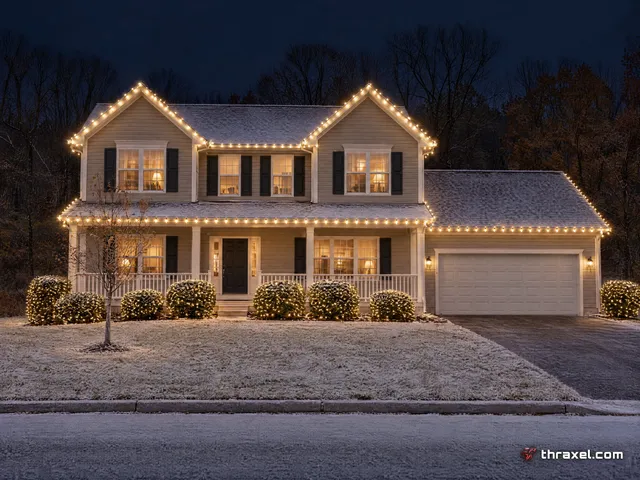
Roofline lights give a house structure. Wreaths and garland give it depth. When they share one white tone, sit at matching scale and are placed with restraint, the three read as a single design. When they do not, the house looks like three separate purchases. Here is how we combine them.

One story, three layers
Think of a finished display as three layers at three distances. The roofline lights are the far layer, read from the road. The wrapped trees and lit shrubs are the middle layer, read from the driveway. Wreaths and garland are the near layer, read from the walk and the porch. Each layer has a job, and the display works when nothing in the near layer tries to compete with the far one.
The single rule that ties the layers together is the white. Warm white on the roof means warm white in the garland and warm white in the wreath. A pure-white pre-lit wreath from a store hung on a warm-white house is the most common way a good display gets ruined, and it is visible from the street.
Wreaths: where and how big
A wreath is a focal point, so it goes where the eye should land. The front door is the default. A center gable is the second spot on a house with a strong peak. Windows are the third, and only when there are enough of them to make a rhythm: one wreath on one window looks like an accident, one on each of five windows looks like a plan.
Scale is where most wreaths go wrong. A door wreath should fill most of the door's width without touching the frame. A gable wreath needs to be much larger than you think, because it is viewed from 60 feet; the standard 24-inch ring disappears up there. Window wreaths can be smaller and should all match.
Lit wreaths use mini lights woven through the greenery so the whole ring glows. Bows are optional, and a single red bow on warm white is the accent that almost always works. Power for a door wreath usually comes from a porch outlet and for a gable wreath from the roofline run, which is one reason we plan the greenery and the lights together.
Garland: the connector
Garland does the job of linking the roofline to the ground. It frames the door, follows the porch rail, wraps the columns and, on some houses, swags along the porch roof. Where a wreath is a point, garland is a line, and it should follow lines the house already has rather than invent new ones.
Fullness matters more than length. Thin garland stretched to cover a long rail looks like rope. Full garland, doubled where needed, looks like it grew there. We use commercial greenery, the same kind stocked in the wholesale catalog our approved installers buy from, because it holds its shape in wind and rain and comes back next year from storage without shedding.
Lit garland gets minis woven along its length before it goes up, so the wire is buried in the greenery and only the glow shows. A porch rail in lit garland, columns wrapped in the same, and a door framed in it is the full near layer on a farmhouse porch in Zelienople or a colonial entry in Sewickley.
- Door frame: the priority spot for garland
- Porch rail and columns: the connector to the roofline
- Swags along a porch roof: only on houses with a deep porch
- Always full, always the same white as the roof
Lights: the structure the greenery hangs on
The roofline is the skeleton. Warm white C9 along the eave and gables sets the frame that the greenery decorates, and it should be installed before any wreath or garland is placed so the near layer can be sized against it. Trees in the yard, wrapped in minis, bridge the distance between the roof and the porch.
Where the layers meet, the lights should hand off cleanly. A gable wreath sits inside a lit peak, so the peak's C9 outline frames the wreath's glow. Garland on the porch roof runs just below the porch's C9 line, so from the street the two read as one thick band. The bulb-size half of this decision is explained at thraxel.com/blog/c9-vs-mini-christmas-lights/.
Color and restraint
Greenery is already a color. Deep green against brick or white siding is doing visual work before any bulb comes on, which is why greenery displays look best in warm white alone. Add red bows and you have two accents. Add multicolor lights through the garland as well and the porch turns into noise.
If the roofline is multicolor, keep the greenery warm white or unlit and let the roof carry the color. If the roofline is warm white, one red element in the greenery, bows or a single red-lit wreath, is the accent. Two colors, held apart, is the ceiling. The full argument on color is at thraxel.com/blog/warm-white-vs-multicolor-christmas-lights/.
Weather, install and January
Western PA weather is hard on greenery. Wind pulls at swags, freezing rain weighs down garland, and a wreath on an exposed gable takes everything the sky throws at it. Everything is secured with clips and ties that hold through a storm and come off cleanly, never with staples or nails into the house, and any piece that comes loose or goes dark in season is fixed within 24 to 48 hours at no charge.
Greenery is installed with the lights in one visit and comes down with them starting January 4 as weather permits. Each wreath and run of garland is labeled by its spot on the house and stored off-season with the strands, so next year the same door wreath goes back on the same door. It is all one service, laid out at thraxel.com/christmas/. Tell Tyson what greenery you have in mind when you call or text 724-859-4390 and the render will include it.