Bulb basics
C9 vs mini Christmas lights: pick the right bulb for the right job
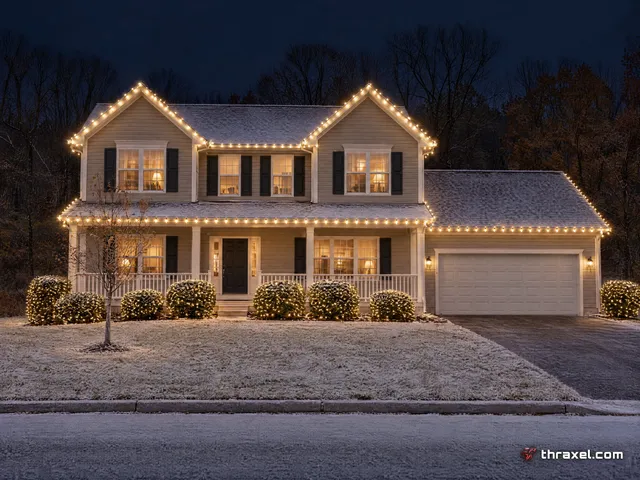
C9 bulbs belong on the roofline. Mini lights belong on trees, greenery and railings. The homes that look off usually have those two swapped. Here is how we decide which bulb goes where on a Western PA house.

Straight answer first
Use C9 bulbs to trace the architecture: eaves, ridgelines, gables, the top of a porch. Use mini lights to add depth: wrapped trunks, garland, wreaths, shrubs and railings. A C9 on a shrub looks clumsy, and a mini strand along a roofline disappears from across the street. Almost every display we design uses both, in those roles.
The reason comes down to scale and distance. A roofline is viewed from the sidewalk or the road, so it needs a bulb big enough to register at 60 feet. A tree or a porch rail is viewed up close, where hundreds of small points of light read as texture. Match the bulb to the viewing distance and the house looks intentional.
What a C9 does well
The C9 is the big bulb, the one the size of your thumb that older Western PA neighborhoods grew up with. On a commercial-grade run, the bulbs sit in a socket wire at a fixed, even spacing, so the line along the eave is perfectly regular. That regularity is what makes a house look professionally lit instead of decorated.
Modern C9s are LED. They stay cool, draw a fraction of the power of the old incandescent glass, and a strand does not go dark because one bulb failed. The faceted or smooth lens options change the look: faceted throws sparkle, smooth gives a cleaner, more modern glow. Warm white smooth C9 on a brick colonial is the look most of our customers in Butler and Armstrong counties ask for by name.
Where C9s struggle is anywhere the line has to bend tightly. Around a wreath, up a spiral column or through a shrub, the bulb spacing fights the shape. That is the point where we hand off to minis.
- Best on: eaves, ridgelines, gables, porch roofs, fence tops, commercial parapets
- Read distance: from the street and beyond
- Look: bold, classic, one clean line
What mini lights do well
Mini lights are the small bulbs on green or white wire, usually a few inches apart. Their job is density. Wrapped tight around a trunk, they turn a bare maple into a glowing column. Woven through garland on a porch rail, they give the greenery a spine of light. On a wreath, they make the whole ring glow instead of showing a handful of dots.
The wide-angle style is the one we lean on outdoors because the lens spreads light in every direction, so the wrap looks even from any angle. Minis also let you shape things C9s cannot: a spiral up a column, a net over a boxwood, a cascade off a porch.
The trade-off is that minis vanish at distance on a long straight run. Put them alone on a 40-foot eave and from the road the house looks like it has a faint outline instead of a lit roofline. That is the single most common mistake we see on DIY homes in the river towns.
- Best on: tree trunks and branches, garland, wreaths, shrubs, railings, columns
- Read distance: up close, from the walk and the porch
- Look: dense, soft, textured
Where each one goes on a typical house
Picture a two-story brick home in Ford City with a front porch and two maples in the yard. C9 traces the main roofline and the porch roof. Minis wrap both maple trunks and run through garland on the porch rail and around the door. A wreath with minis hangs in the center gable. From the street the eye reads the C9 outline first, then the warm glow of the trees, then the porch detail as you walk up.
On a ranch, the roofline is lower and closer, so C9 still wins for the eave but the trees and shrubs carry more of the look. On a Cape Cod with dormers, C9 on the main eave and around each dormer, with minis in the window boxes and along the walk. The pattern holds: big bulb for lines, small bulb for volume.
Businesses follow the same logic at a bigger scale. A restaurant or a quick-service building with a flat parapet gets multicolor or warm C9 along the top edge, which is exactly what a driver sees from the road. We cover the commercial version at thraxel.com/blog/quick-service-restaurant-christmas-lights/.
Color, and the honest trade-offs
Both bulb types come in warm white, pure white, multicolor and single colors, so the C9-or-mini decision is separate from the color decision. If you want the classic red, green, blue, orange and yellow look, C9 multicolor on the roofline is the most nostalgic version of it. We break the color choice down at thraxel.com/blog/warm-white-vs-multicolor-christmas-lights/.
One honest caution: mixing warm white and pure white on the same house looks like a mistake, even when it is intentional. Pick one white and hold it across C9s, minis and any pre-lit greenery. The second caution is quality. Big-box mini strands and C9 sets are built to a price, and a strand that fails on December 22 is not a bargain. Our crews install commercial-grade product from the same catalog our approved installers buy from, and any failure in season is fixed within a day or two at no cost.
How we decide it for you
You do not have to memorize any of this. During the free consult we look at the house, the trees and the sightlines from the road, then draw both bulb types onto a render of your actual property so you can see the balance before it goes up. Details of the seasonal program are at thraxel.com/christmas/.
If you already know you want C9 on the roof and wrapped trees in the yard, mention that when you reach out at 724-859-4390 by call or text, and the render will come back with exactly that. If you have no idea, say that instead. Most people do not, and that is what the mock-up is for.