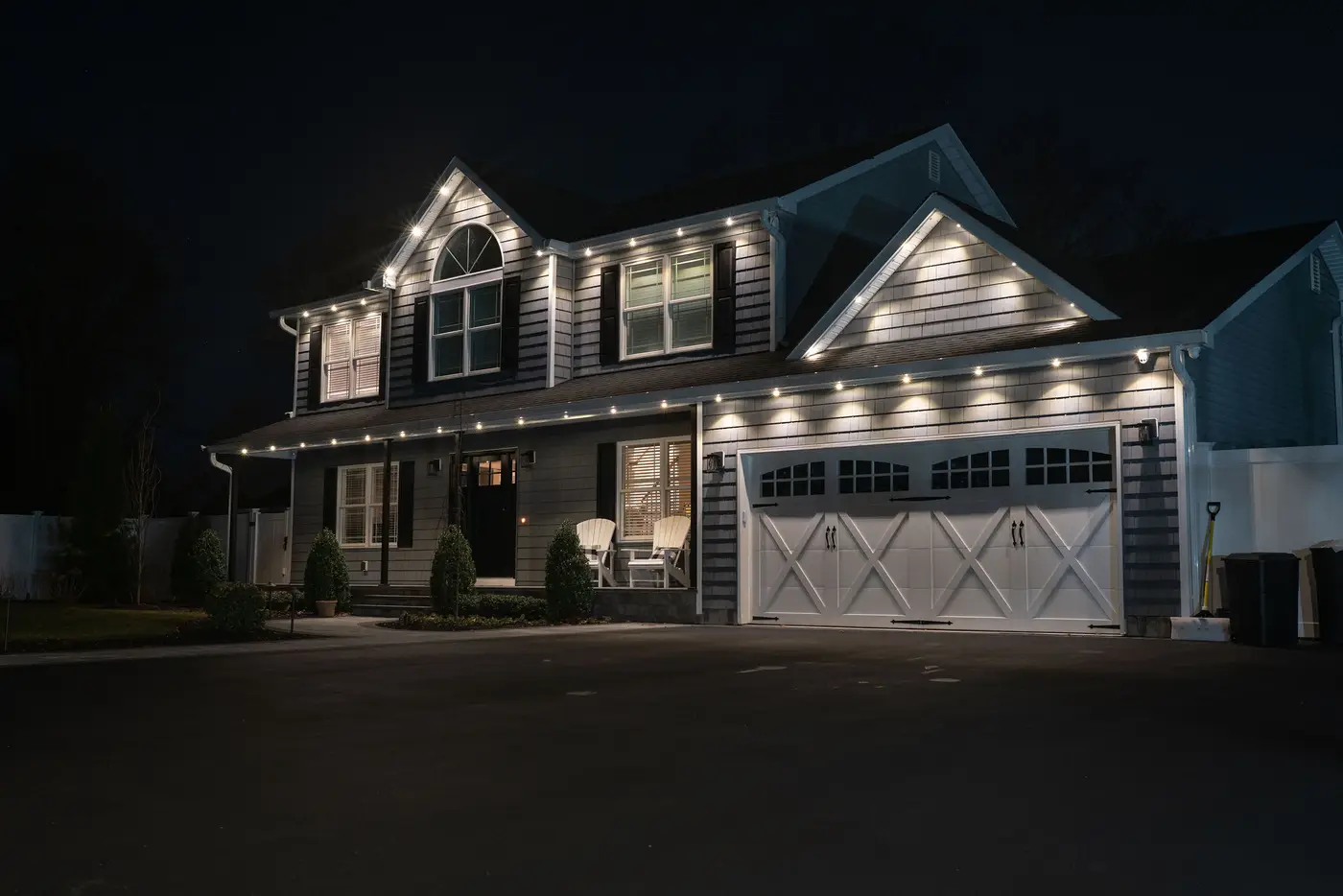
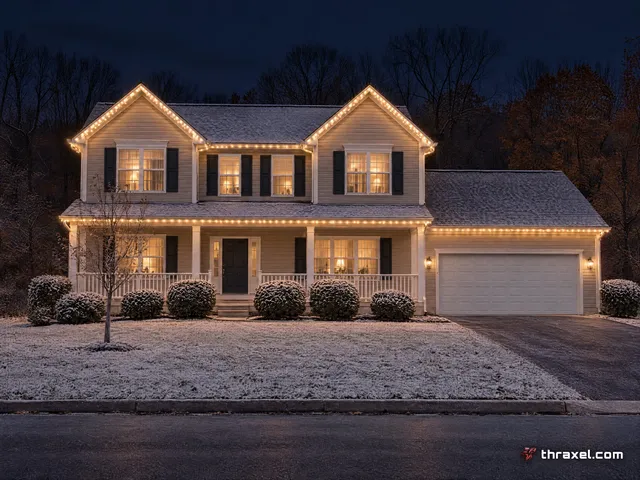
Winter
Winter care for permanent lighting: mostly, leave it alone
A Thraxel roofline is built to sit through a Western Pennsylvania winter without you doing a thing. The little bit of care that matters is about what not to do: no ice chipping, no roof rakes on the track, no ladders in January. Here is the full list.
What the system is rated for
The pixels sit inside IP67 marine-grade silicone, which means they are sealed against dust and against being submerged. The wire is 16-gauge, heavier than what most kit lighting uses, so it does not go brittle at single-digit temperatures. The housing is salt-tested, which matters in river towns where road salt drifts onto everything within a block of a state route.
The aluminum track is color-matched and fastened tight to the fascia, not hanging from clips. Wind does not get behind it, snow does not pile on it the way it piles on C9 strands, and ice forms over it rather than pulling on it. It is a piece of the house, not something attached to the house.
We designed it around the winters we grew up in around Kittanning. Lake-effect bands off Erie, freezing rain in the Laurel Highlands, the wet heavy snow that hits Butler County in March. If you want the engineering detail, thraxel.com/blog/will-permanent-lights-survive-pa-winter/ goes deep on each one.
The do-not-do list
Winter damage to permanent lighting almost never comes from the weather. It comes from people fighting the weather. A homeowner chipping ice off the eave with a hammer, a roof rake dragged down over the track edge, a gutter cleaner in December leaning an aluminum ladder against the fascia. Each of those can do in ten seconds what a whole season of snow cannot.
Ice on the track is fine. Icicles hanging off the track are fine. The lights shine through both, and in a lot of homes the effect is better than a bare roofline. If ice dams are a recurring issue on your house that is a roof ventilation problem worth solving on its own, and thraxel.com/blog/ice-dams-and-roofline-lighting/ covers how the track behaves when they form.
- Do not chip, scrape or hammer ice near the track
- Do not run a roof rake over the eave edge where track is mounted
- Tell any winter contractor, gutter, roof or siding, that there is lighting track on the fascia
- Do not lean ladders against track sections
- Do not cut power to the controller to save electricity, it costs about $52.80 a year to run
Keep the controller warm and powered
The controller is the only part of the system that prefers not to freeze. Ours are installed indoors or in a sealed enclosure for that reason. If yours is in a detached garage that gets down to outdoor temperature, that is fine, it is rated for it, but check that the enclosure is still closed and dry after any storm that drove snow sideways.
Power is the bigger issue. Winter storms knock out power across the Allegheny valley more than any other season, and the controller reboots with the house. If the roofline stays dark after the power comes back, power-cycle the controller once the router is fully up. Most of the time that is the entire fix. If not, thraxel.com/blog/controller-reset-and-wifi-issues/ has the next steps.
Running scenes through the cold
There is no reason to shut a permanent system down for winter. Each pixel draws roughly 0.3 watts, so a typical 168-LED install on for six hours a night runs about $52.80 a year. Leaving it in Everyday Warm through January costs less than one holiday dinner and gives the house a finished look on the darkest nights of the year.
Schedules earn their keep in winter. Set the roofline to come on at dusk and off at bedtime and stop thinking about it. The Christmas scene can be set to end after Epiphany and hand off to a warm white without anyone touching a phone, which is the whole point of not hanging seasonal lights anymore.
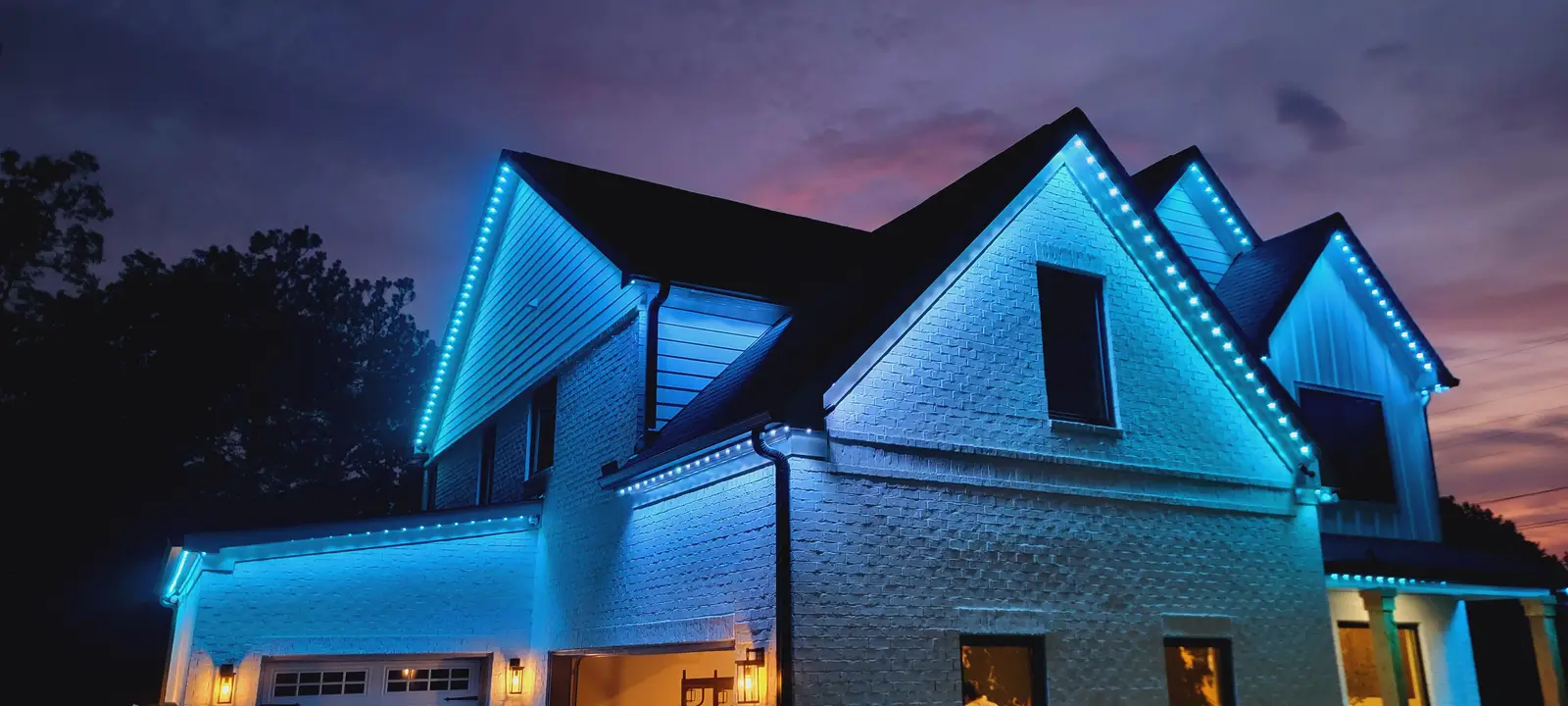
One thing to expect: colors read differently against snow. A deep red or blue on a snow-covered roof looks brighter and more saturated than it did in October because the snow is throwing the light back. If a scene looks too loud in January, drop the brightness a notch rather than changing the color.
What to look at after a big storm
After heavy ice, high wind or a limb coming down, do a walk around the house from the ground in daylight and again at night with a solid white scene running. In daylight you are looking for track that has shifted or a section that is visibly pulled away from the fascia. At night you are looking for dark pixels or a dark run.
A single dark pixel is a same-day repair and does not need to wait until spring. A dark run starting at one point is a data or power break and we want to see it soon, because an open connector in freeze-thaw weather takes on water. Send Thraxel a phone photo at 724-859-4390 and we will tell you what it is.
Everything you find is covered under 3 years on parts and 1 year on labor when it is a defect, and repairable at a small service cost when it is storm damage. Either way, you do not go up a ladder in February. That was the deal when you bought the system.
Spring is when we clean up
Winter care is passive. Spring is when the active work happens, and it is light. Once the salt and grit stop flying, a rinse of the track and a check of every zone in the app puts the system right for the summer scenes. We cover the how-to in thraxel.com/blog/cleaning-exterior-light-track/, and an annual preventive visit handles all of it if you would rather not.
If you are reading this in the fall and still deciding, know that this is the calm side of the trade-off. Seasonal Christmas lights get serviced in the cold, on a ladder, in December. A permanent roofline gets glanced at from the driveway. The details are at thraxel.com/permanent/ and the quote is free.