Straight talk
Is permanent lighting worth it? Here is the honest answer
For most homeowners who plan to stay put and want the house lit more than one month a year, yes. For anyone selling soon, replacing the roof, or only ever wanting warm white in December, no. We would rather tell you which one you are than sell you the wrong thing.

The test we use on every consult
Worth it is not a property of the product. It is a property of the match between the product and the house. So instead of arguing that permanent lighting is always the right call, we ask three questions in the driveway and let the answers decide.
How many occasions a year would you want the house lit? How long do you expect to live here? And is any exterior work coming in the next twelve months? Two or more occasions, five or more years, and no roof or siding job on the calendar is a clean yes. Miss two of the three and we usually point you to the seasonal program at thraxel.com/christmas/ instead.
The demo case does the rest. Four live RGBWW strips, 128 LEDs, sitting on your driveway and answering to the app in your hand. People know within a minute whether they are the kind of household that will actually use this.
The money case, without a Thraxel price in it
We keep prices off the blog because every roofline is different and the quote is free. The shape of the value is not a secret, though. Seasonal professional lighting is a fee paid every winter, and national industry estimates commonly put it between roughly $500 and $2,500 or more per season for a typical home. Permanent lighting is a single install, commonly estimated at roughly $20 to $50 per linear foot, followed by about $52.80 a year in electricity for a typical 168-LED system.
On those ranges the permanent system usually passes the cumulative seasonal cost somewhere between the third and sixth winter. Every year after that, it is the cheaper way to have a lit house. The full breakdown, year by year, is at thraxel.com/blog/five-year-cost-permanent-vs-seasonal-lights/.
Then there is the appraisal side. In our 2023 to 2025 residential tracking, homes with permanent lighting appraised 3 to 7 percent higher on average. That is directional, not guaranteed, and an appraiser in Murrysville may see it differently from one in Erie. But it means the system is not a sunk cost the way a seasonal fee is.
The value nobody puts on a spreadsheet
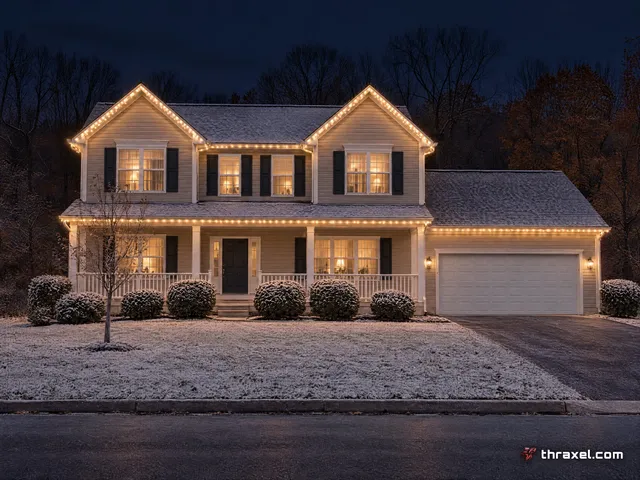
Ask someone who has had a permanent system for a year what they like most and the answer is rarely Christmas. It is the Tuesday in February when the house looks finished at 6 p.m. It is the Halloween scene the kids on the street ask about. It is switching to black and gold from the couch when the Steelers kick off, and back to Everyday Warm when the game ends.
There is also the ladder. Every November in Western PA someone in the neighborhood goes up on an extension ladder with a string of lights and comes down the hard way. A permanent system takes that out of the household calendar for good. For older homeowners and for anyone whose spouse has already said the words never again, that alone settles the question.
And there is the HOA angle. Color-matched aluminum track tucked tight to the fascia is effectively invisible by day, and it has passed every HOA we have worked in. No deadline to take anything down, because nothing is up.
When it is not worth it
Selling within a year or two: skip it. The payback window closes before you reach it, and the appraisal lift, while real in our tracking, is not something to bet a purchase on. Hang seasonal lights, sell the house, and do permanent at the next one.
Roof, fascia, gutters or siding on the schedule: wait. Mounting track to material that is coming off is wasted money, and we will tell you that on the consult even though it costs us the job this season.
One holiday, warm white, glass bulbs: seasonal. If what you love is the look of C9 glass on the eaves for six weeks and nothing else, the seasonal program gives you exactly that with a costumed crew, in-season repairs at no charge, and storage. Permanent pixels will imitate it well, but they are the wrong tool if that is the whole job.
- Selling inside two years
- Exterior work scheduled in the next twelve months
- Only want lights for one holiday
- Specifically want the glass C9 look and nothing else
When it is clearly worth it
Staying five years or more. Two or more occasions a year, even if the second one is just game day. An HOA that makes seasonal lights a hassle. A two-story roofline that nobody in the house wants to climb. A patio, pool or dock you would use more if it were lit. Any two of those and the math and the lifestyle both point the same way.
Newer construction in places like Gibsonia and Cranberry Township tends to check most of the boxes at once: a family planning to stay, an HOA, a lot of roof geometry, and a backyard built for entertaining. Older river-town homes in Kittanning and Tarentum often check them too, just with a simpler roofline and a porch that lights beautifully.
The system itself holds up its end. IP67 marine-grade silicone on 16-gauge wire, salt-tested, backed by 3 years on parts and 1 year on labor. Individually addressable pixels mean one failure is one pixel, replaced typically the same day.
Find out which one you are
The consultation is free, and so is the render of your house that follows within 24 hours. Tyson brings the demo case, walks the roofline, asks the three questions, and tells you straight if seasonal is the better fit. Book at thraxel.com/quote/ or text him at 724-859-4390.
If you want a shorter version of this question answered for the holidays specifically, thraxel.com/blog/are-permanent-christmas-lights-worth-it/ tackles it head-on. Financing at 0% APR for up to 24 months is available to qualifying buyers if the answer turns out to be yes.