Head to head
Permanent vs seasonal Christmas lights: which one belongs on your house?
Both put a lit roofline on your house in December. One comes down on January 4. The other stays up, changes color for July 4th, and costs about $52.80 a year to run. Here is how we tell homeowners to choose.

The short version
Seasonal Christmas lighting is a service. We design it, hang it in November, fix anything that fails within 24 to 48 hours, take it down starting January 4, and store it until next year. You pay per season and never touch a ladder.
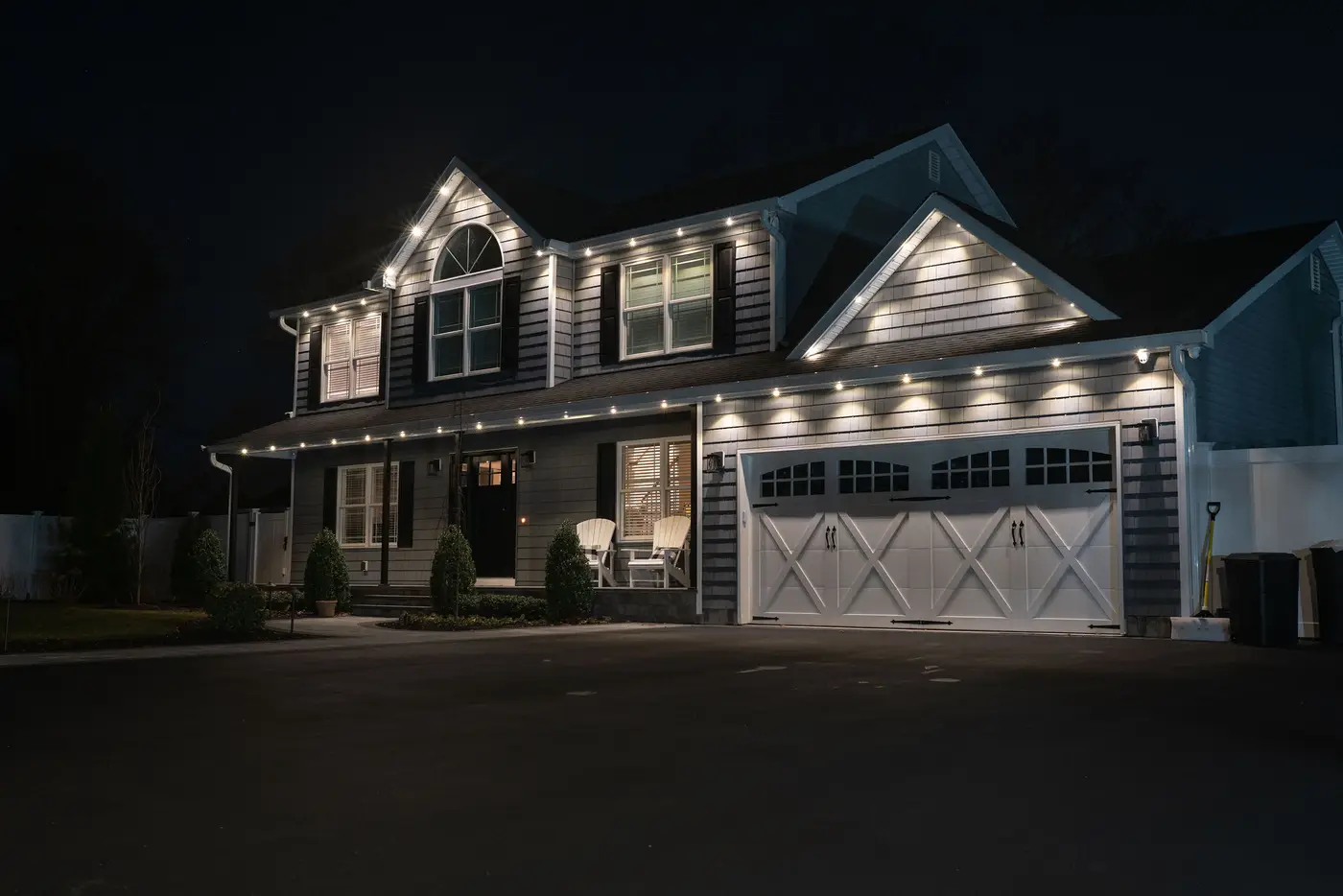
Permanent lighting is an installation. Color-matched track goes under your eaves once, the pixels inside it can produce 16 million colors plus a true 2700K warm white, and you run scenes from the Thraxel Lighting app for Christmas, Halloween, game day, or any Tuesday.
If you only ever want warm white in December and nothing else, seasonal is the cheaper way in. If you want the house lit more than one month a year, permanent wins on cost inside a few seasons. Most of the homes we quote in Armstrong and Butler County land on permanent once they see the render.
What seasonal lighting gets right
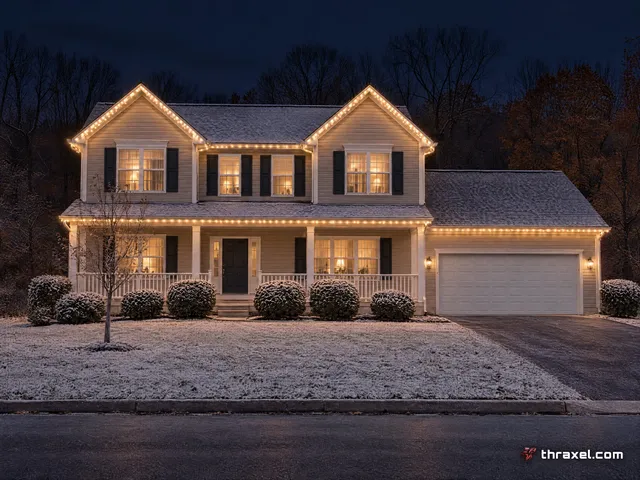
Traditional C9 bulbs on a roofline have a look that pixels imitate but do not perfectly copy. The glass bulb, the socket spacing, the slight glow bleed onto the shingles. For a lot of Western PA homes, especially older brick and stone, that is the look their family grew up with.
Seasonal is also the right call when a house is about to be sold, re-roofed or re-sided. There is no point mounting track to fascia you are replacing in April. Hang lights for one winter, then decide on the permanent system when the exterior work is finished.
Our seasonal program is full white-glove: mock-up, install by a costumed crew with the music going, in-season repairs at no charge, and labeled storage. Details are on thraxel.com/christmas/.
- Best for: one holiday a year, homes about to be renovated, families who want classic C9 glass
- You pay: per season, including takedown and storage
- You handle: nothing
What permanent lighting gets right
A permanent system is on the house 365 days a year and invisible during 364 daylight hours of them. The aluminum track is color-matched to your trim and tucked tight to the fascia. From the sidewalk you see a clean roofline, not a lighting product. It has passed every HOA we have worked in.
Because every pixel is individually addressable, one roofline runs Everyday Warm on a normal night, black and gold on a Sunday, orange and purple at the end of October, and red and green from Thanksgiving to Epiphany. The scene changes from your phone, not from a ladder.
The system is IP67 marine-grade silicone on 16-gauge wire. It is built to sit through ice, lake-effect snow and a July thunderstorm without anyone going up to check on it. The full spec is at thraxel.com/permanent/.
- Best for: homes that want lighting for more than one holiday, HOA neighborhoods, anyone done with ladders for good
- You pay: once, with 0% APR financing up to 24 months for qualifying buyers
- You handle: tapping a scene
Cost over five seasons, honestly
We do not print Thraxel prices in blog posts because every roofline is different, and the quote is free. But the shape of the math is the same for every house. Seasonal lighting is a recurring line item: the same service fee every November, forever. Permanent lighting is a larger single number plus about $52.80 a year in electricity for a typical 168-LED install running six hours a night.
National industry estimates commonly put permanent roofline systems between roughly $20 and $50 per linear foot installed, and professional seasonal installs between roughly $2 and $6 per linear foot per year. Your property will differ, which is why we come out and measure. On those ranges, a permanent system typically catches the cumulative cost of seasonal service somewhere between year three and year six, then keeps paying.
What the ranges miss is the value of the other eleven months. Seasonal lights give you December. Permanent lights give you the Fourth, Halloween, the Steelers schedule, a landscape wash on a summer patio night, and a house that looks finished after dark all year. See thraxel.com/blog/five-year-cost-permanent-vs-seasonal-lights/ for the full breakdown.
The questions we ask on a consult
How many times a year do you want the house lit? One means seasonal is fine. Two or more means permanent starts to make sense.
Is there an HOA? Permanent track is the easier approval because there is nothing to see by day and nothing to take down late. Seasonal lights on an HOA street usually come with a deadline for removal.
Are you planning exterior work in the next year? If so, seasonal now, permanent after. Is anyone in the house done climbing ladders? Then permanent, no discussion.
We bring a demo case to the driveway on every consult: four live RGBWW strips, 128 LEDs, controlled from the app in your hand. Most people decide in the first thirty seconds of scrolling through colors.
What we recommend
For a first-time buyer who wants classic warm white for one month and has an older home, seasonal C9 is a great product and we are proud of how we run it.
For anyone who has said the words never again about a ladder in November, or who wants the house to do more than one trick, permanent is the better long-term buy. It is one install, one warranty of 3 years on parts and 1 year on labor, and one app.
Either way it starts the same: a free on-site consultation and a design mock-up of your actual house within 24 hours. Request one at thraxel.com/quote/ or text Thraxel at 724-859-4390 and we will tell you which one you actually need.