Return on the install
Where the return on permanent lighting actually comes from
Permanent lighting pays back in three places: what you stop paying every winter, what it costs to run, and what it may do for your home's value. Here is each piece, with the real numbers Thraxel can put behind them.

The recurring cost you stop paying
Every winter a homeowner pays for seasonal Christmas lighting, that fee resets. National industry estimates commonly run roughly $2 to $6 per linear foot or $500 to $2,500 or more for a typical home per season, and that number does not shrink over time.
A permanent system replaces that recurring line with a single installation, then adds the ability to light the house for more than one month a year at no additional recurring cost. Over five or six seasons, the math on that trade is covered fully at thraxel.com/blog/hidden-costs-of-diy-christmas-lights/ and in the seasonal-versus-permanent comparison on the blog.
The return here is not abstract. It shows up as a line item that simply stops appearing on the household budget every November, freeing that money for whatever else the season calls for.
What it actually costs to run
A typical 168-LED permanent install running six hours a night costs about $52.80 a year in electricity, since each pixel draws roughly 0.3 watts. That is a real, specific number Thraxel can point to, not a rough estimate.
Compared against the electricity most homes already spend on porch lights, holiday inflatables or string lights run manually each season, the incremental cost of a full RGBWW system left running most nights is genuinely small.
It also does not scale linearly with more zones the way people sometimes assume. Adding landscape or fence line lighting increases fixture count and therefore total draw, but each individual pixel still only pulls roughly 0.3 watts, so the per-zone cost stays modest.
What the real estate tracking shows
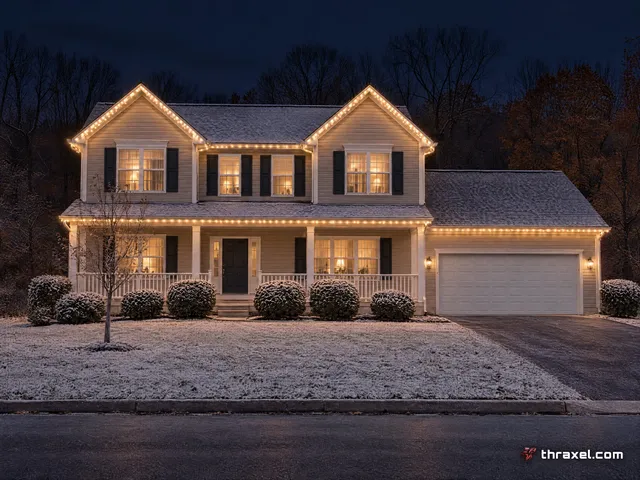
In Thraxel's own 2023 to 2025 residential project tracking, homes with permanent lighting appraised an average of 3 to 7 percent higher. This is directional, not a guarantee, and every appraisal depends on far more than exterior lighting, but the pattern held across the properties tracked.
One specific example: an Erie, PA colonial with 312 feet of roofline across six zones appraised $42,000 higher, and two neighbors on the same street signed for their own installs that same season. A craftsman with a 14-zone uplight package sold over asking within four days of listing.
These figures come from Thraxel's own tracked residential projects rather than a third-party study, which is exactly why they are presented with the caveat attached. They describe a real pattern in real homes Thraxel has worked on, not a national statistic pulled from an unrelated dataset.
- 3 to 7 percent average appraisal increase, directional not guaranteed
- One Erie colonial appraised $42,000 higher after a 6-zone install
- 58 percent neighbor inquiry rate following a residential install
The neighbor effect, quietly part of the ROI
On 11 of the last 14 residential permanent installs Thraxel has tracked, at least one neighbor on the same street booked an install within 18 months. The overall neighbor inquiry rate sits at 58 percent. This is not a return that lands in your bank account, but it does suggest a visible install changes how a street is perceived, block by block.
For homeowners weighing whether the upfront cost is worth it, this pattern is one more data point, alongside the direct appraisal figures, worth factoring in.
It also tends to show up fastest in denser neighborhoods, where one lit roofline is visible from several others every night, compared to a rural property where the nearest house might be a quarter mile away.
What ROI does not include
None of these figures are a promise about your specific house. Appraisals depend on comparable sales, local market conditions, and dozens of factors that have nothing to do with roofline lighting. Thraxel is careful to present this tracking as directional, exactly as it should be treated.
What is not directional is the warranty and the electricity cost, both of which are fixed terms: three years on parts, one year on labor, and roughly $52.80 a year to run a typical system.
A useful way to think about it: the appraisal and neighbor figures are a bonus that may or may not apply to your street, while the warranty terms and running cost are the reliable floor of the return, true for every install regardless of market conditions.
Getting your own numbers
The only way to know what permanent lighting would cost and potentially return on your specific home is a free consultation and render, which is where Tyson measures your actual roofline and zones rather than working off an average.
Start at thraxel.com/quote/ or reach Thraxel directly at 724-859-4390 to get a number built around your house.
The consultation is also where financing gets discussed if it is relevant to how you want to structure the cost, with 0% APR available for up to 24 months for qualifying buyers through Thraxel's financing partner.