Energy math
How much electricity does permanent exterior lighting actually use?
About $52.80 a year for a typical 168-LED system running six hours a night. That number surprises most homeowners who assume year-round lighting means a year-round power bill.
The number homeowners actually ask about
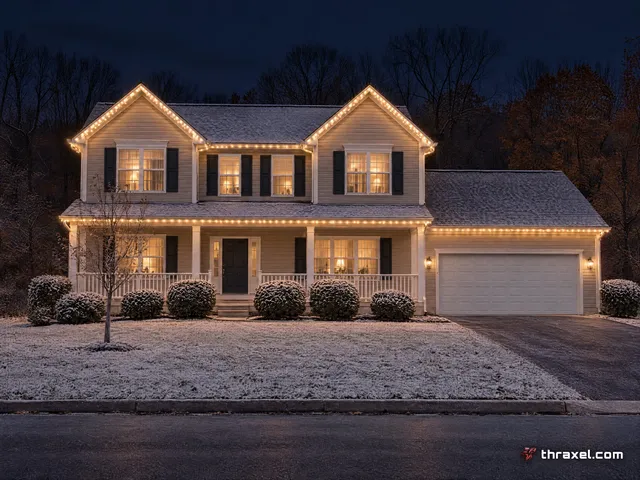
Every consult ends up here eventually. A typical 168-LED permanent installation, run six hours a night, costs roughly $52.80 a year in electricity. That is the figure we give when someone asks what the system does to their power bill, and it holds up whether the house is a small ranch or a wide colonial with a long roofline.
The reason the number stays low is the hardware itself. A single RGBWW pixel pulls only about 0.3 watts. Multiply that by 168 pixels and six hours a night, add the utility rate, and you land near that same annual figure across most of Western Pennsylvania.
Bigger houses use more pixels and land on a slightly bigger number, smaller houses less. The shape of the math does not change: LED draw per pixel is small, and the system only pulls power while it is actually lit.
Where the wattage actually goes
A pixel is not a bulb pulling a fixed load around the clock. It draws power only when it is on, and only at the brightness and color the app is currently running. A dim Everyday Warm scene pulls less than a full-brightness Christmas red and green display.
The controller and transformer add a small, steady draw of their own, but it is a fraction of what the pixels use. Most of the annual number traces straight back to LED count and nightly runtime, not to anything hidden in the electronics.
This is also why a permanent system beats old-style incandescent strand lighting on power draw by a wide margin. LEDs convert most of their energy into light rather than heat, which is the whole reason the wattage per pixel stays as low as it does.
What changes your number up or down
Runtime is the biggest lever. A house that runs lights from dusk until 2 a.m. uses more power than one that runs a scene from sunset to 11 p.m. Scheduling inside the app is the easiest way to manage the annual cost without touching the install itself.
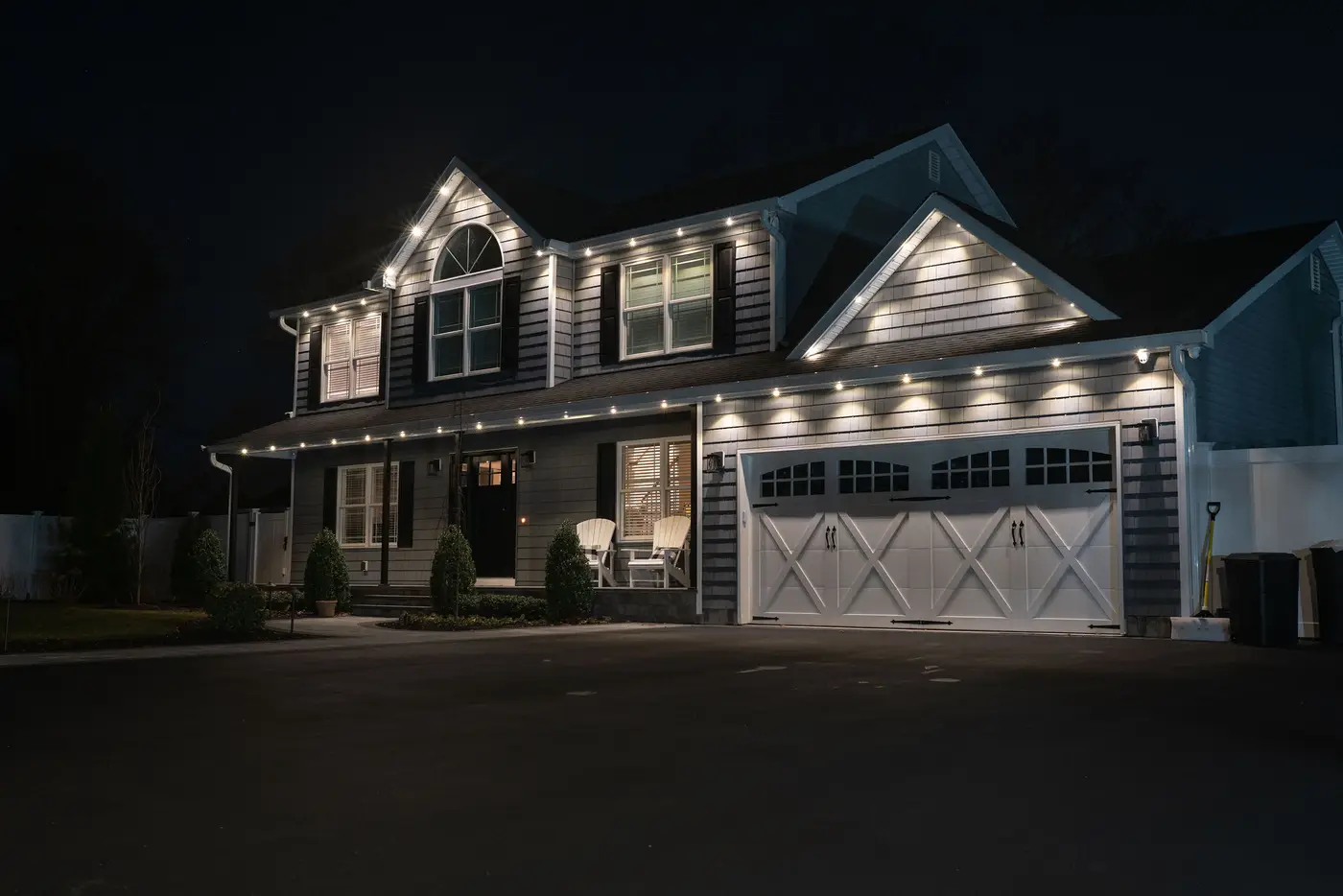
Pixel count scales with roofline length. A 400-foot colonial with several zones will land above the $52.80 baseline; a smaller ranch with a shorter run will land below it. A free quote includes a pixel count specific to your house, not a generic estimate.
Brightness and color matter less than most people expect, since warm white and full color both draw from LEDs pulling a fraction of a watt each. The bigger swing is always how many hours the system is actually lit.
- Roughly 0.3 W per pixel
- About $52.80 a year for 168 LEDs at 6 hours a night
- Runtime and pixel count are the two levers that move the number
How that stacks up against what a house already runs
A single outdoor floodlight left on all night for a season can rival or beat the annual cost of a full permanent lighting system, because incandescent and even some older LED floods draw far more per fixture than an individually addressable pixel does.
Homeowners comparing the system to hardware-store string lights are usually surprised in the other direction. Cheap incandescent C9 strands draw multiple watts per bulb, so a 100-bulb strand run for a season can cost more in power than the permanent system costs for a full year.
None of this changes the honest caveat: your house is not the baseline house. The pixel count in your quote determines your actual number, and that count comes from measuring your roofline in person, not from a generic online calculator.
Reading your own usage
The Thraxel Lighting app shows which scenes are running and lets you set schedules, so the easiest way to manage the bill is to pick a stop time that matches when the house actually needs to be lit, rather than leaving a scene running all night out of habit.
If a scene runs longer over the holidays, expect the December bill to bump up and the rest of the year to sit lower, since most homes do not run full-brightness Christmas colors on a random Tuesday in March.
Anyone who wants a harder number for their specific roofline can ask for it during the free consultation. thraxel.com/quote/ starts that process, and the design mock-up that follows includes the pixel count your house needs.
The honest limit of this comparison
Electricity is a small line item next to the install itself, and we say that plainly rather than oversell the savings angle. The case for permanent lighting is mostly about not touching a ladder and running more than one holiday off the same system, not about beating your power bill.
If low power draw is the only thing driving the decision, seasonal Christmas lighting run for one month a year will always cost less in electricity than a system lit for months at a time, simply on total hours run. See thraxel.com/blog/permanent-vs-seasonal-christmas-lights/ for the fuller side-by-side.
For most Western PA homeowners the electricity question gets answered in the first few minutes of a consult and stops being a concern. The bigger questions are usually about zones, scenes and where the track goes, covered at thraxel.com/permanent/.