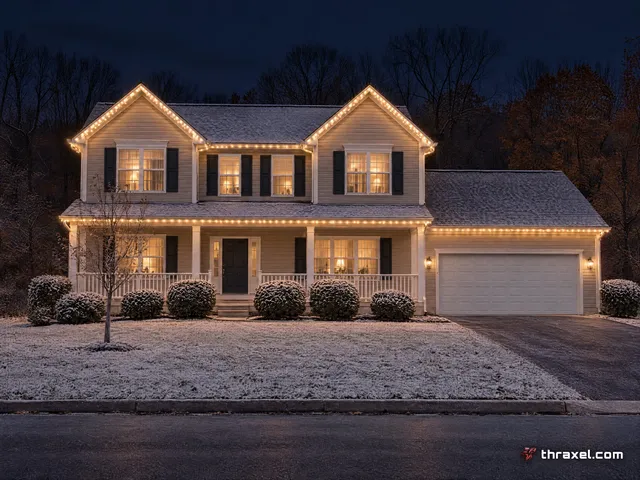
Invisible by day
Color-matched track: the reason nobody can find your lights at noon
Color-matched track is the aluminum channel that holds the pixels and is finished to match your fascia or trim. Tucked tight against the roofline, it reads as part of the house in daylight. It is the single feature that gets permanent lighting through HOA review.

What the track is
The track is a slim extruded aluminum channel. The RGBWW pixels, their silicone housing and the 16-gauge wire all sit inside it. It mounts along the fascia board, under the drip edge of the roof, following every peak and return of the house. Aluminum because it does not rust, holds paint, and handles the expansion and contraction of a Pennsylvania freeze-thaw cycle without warping.
Color-matched means exactly that. Before install we identify the color of your fascia, soffit or trim and the track is finished to match it. White trim, bronze trim, the near-black of a modern farmhouse: the track takes on whatever the trim already is. The goal is that a person standing on the sidewalk cannot tell where the trim ends and the track begins.
Why it disappears
Three things make the track vanish. Color, because it matches what is around it. Position, because it is tucked up tight under the eave where the fascia already casts a shadow line. And profile, because it is low and flat rather than round or clipped.
Compare that to seasonal clips or hooks, which hang a visible wire and bulb below the gutter, or to a DIY strip stuck to the face of the trim with adhesive. Those are products on a house. The track is a line on the house, and the eye reads lines on a house as architecture.
The pixels throw light from inside the channel onto the fascia and the wall below. By day the lens openings sit in shadow. The gallery at thraxel.com/gallery/ shows a few installs by day and night if you want to test yourself.
What it means for HOA neighborhoods
Homeowners associations in the Pittsburgh suburbs, Cranberry Township, Wexford and Peters Township mostly regulate what is visible from the street and when. A seasonal display comes with a takedown deadline. A permanent product that is visible in daylight can trigger an architectural review that never ends.
Color-matched track has passed every HOA we have worked in. The reason is simple: there is nothing to see. Boards approve a photograph of a roofline that looks like a roofline. Our design mock-up, delivered within 24 hours of the consult, is usually what gets submitted. We cover the approval process in more depth at thraxel.com/blog/how-to-get-hoa-approval-for-exterior-lighting/.
What the track does besides hide
Hiding is the headline, but the track has a mechanical job too. It holds the pixels in a straight line at a fixed spacing, so the roofline reads as one continuous glow rather than a sag between hooks. It shields the housing from ice sliding off the shingles and from the sun's UV on the south side of the house.
It also keeps the installation clean and reversible. Nothing is stapled to shingles, no holes in the roof deck, no clips bending the drip edge. The track fastens to the fascia, and when a house eventually gets new fascia, the track comes off and goes back on.
- Straight, even pixel spacing along every run
- Ice and UV shield for the silicone housing
- No staples, no roof penetrations, no gutter clips
- Removable for future fascia or siding work
When color-matching is harder
Some houses are honest about being tricky. A multi-color Victorian with painted trim in three shades. A stone home with no fascia at all where the track has to sit on a soffit return. A log cabin with exposed rafter tails. On those we match to the dominant trim color, or sometimes to the roof edge, and the render shows you the choice before any track is cut.
Metal roofs and unusual soffit profiles get handled on the consult, not guessed at. If your house has one of those, say so when you request the quote at thraxel.com/quote/ and Tyson will bring the right sample colors to the driveway.
The short answer
Color-matched track is why permanent lighting can live on a house full time without changing what the house looks like at noon. It is aluminum, finished to your trim, tucked under the eave, holding IP67 pixels on 16-gauge wire. Everything about the system that people worry about by day, this part solves.
The consultation is free and we bring the demo case. Thraxel picks up at 724-859-4390, and a text works just as well.