Why LEDs work
LED efficiency, explained in plain terms
LEDs turn most of their energy into light instead of heat. That single fact is why a permanent system with hundreds of pixels still runs on a small annual power number.

What efficiency actually means here
An incandescent bulb makes light as a byproduct of heat. Most of the electricity it draws leaves as warmth, not light, which is why an old string of C9 bulbs feels warm to the touch and pulls real wattage per bulb. An LED does the opposite, converting most of its draw directly into light.
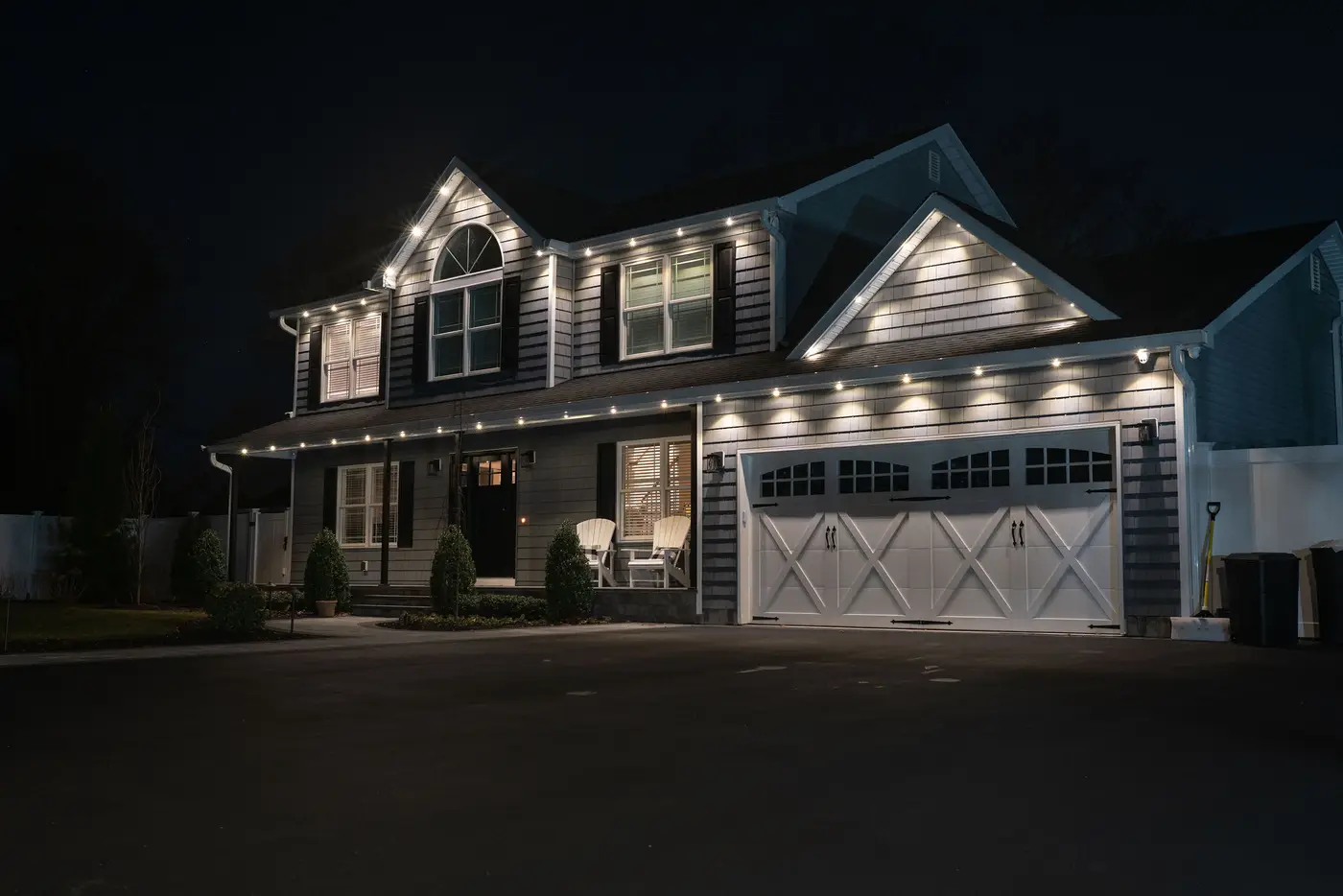
That difference is the entire reason a permanent lighting system with 168 or more individually addressable pixels stays cheap to run. Each RGBWW pixel draws roughly 0.3 watts, a fraction of what an equivalent incandescent bulb pulls to produce comparable brightness.
Multiply a small per-pixel draw by a full roofline and the total stays modest. That is the math behind the roughly $52.80 a year figure for a typical 168-LED install running six hours a night.
Why RGBWW efficiency does not mean dim
Low power draw does not mean low brightness. LED technology produces strong, saturated color and true white light at a fraction of the wattage older lighting technology needed, which is why efficiency and visual impact are not a trade-off here.
The dedicated 2700K warm-white diode inside each RGBWW pixel is part of that efficiency story too. Instead of mixing red, green and blue to fake a white, which wastes energy producing colors the eye then has to blend, the pixel produces true white directly.
Lifespan is part of the efficiency picture
LEDs also last longer under normal use than incandescent bulbs, which matters for a system meant to stay outdoors year-round rather than get swapped out each season. Longer lifespan means fewer replacement trips and less waste over the life of the install.
Individually addressable pixels compound that advantage. If one pixel eventually fails, it is diagnosed and replaced on its own, typically the same day, rather than requiring a whole strand to be pulled and replaced the way older Christmas light strings work.
This is one reason a permanent installation is treated as a long-term fixture rather than a seasonal purchase. The hardware is chosen for years of outdoor exposure, not for a single winter's use and a trip to the attic in January.
How this compares to what a house already runs
A single outdoor floodlight running on an older incandescent or halogen bulb overnight can use more power across a season than a full permanent lighting system does across a year, simply because per-fixture wattage is so much higher on older lighting technology.
This is also the practical case for LED over incandescent in seasonal Christmas lighting, covered in more depth at thraxel.com/blog/led-vs-incandescent-christmas-lights/, where the same efficiency principle applies to strand lighting rather than a permanent install.
The comparison holds even against other LED products. Not every LED string on the market is built the same way, and lower-quality diodes can draw more per bulb than a purpose-built RGBWW pixel designed for individual addressability and long outdoor service life.
What efficiency does not solve
Efficiency is not the main reason most homeowners choose permanent lighting. It is a quiet side benefit next to the bigger draws: no ladder, more than one holiday off the same system, and a roofline that looks finished for the entire year. See thraxel.com/permanent/ for the full picture.
A homeowner focused purely on minimizing electricity use should still weigh total runtime, not just per-pixel draw, since a system run all night every night will always cost more than the same system run for a shorter, scheduled window.