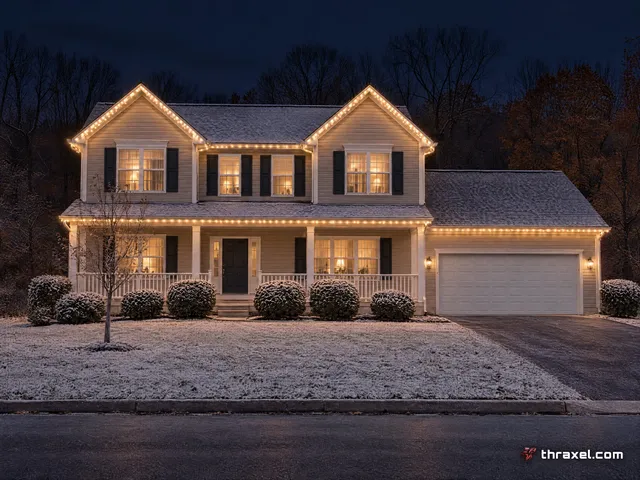
Glass vs pixel
C9 bulbs vs permanent pixels: the look, the calendar and the trade-offs
A C9 bulb is a faceted lens over an LED, spaced along a wire, hung for December. A permanent pixel is a sealed RGBWW diode living in track under the eave all year. They photograph differently, age differently and get controlled differently. Here is how.

The two products, plainly
C9 is a bulb size, about the length of your thumb, with a faceted lens that throws light in every direction. On a seasonal install the bulbs sit in sockets on a wire, clipped to the shingle or gutter edge at fixed spacing. They are warm white or multicolor, chosen when the strand is bought, and they come off the house in January.
A pixel is a tiny RGBWW LED sealed in IP67 silicone and seated in aluminum track that is color-matched to the trim. Each pixel is individually addressable, so it can be any of 16 million colors or a true 2700K warm white on its own, and the whole run is driven from the Thraxel Lighting app. It goes up once.
How they look from the street
C9 bulbs have presence. The lens is large, the glow bleeds onto the shingles, and the spacing reads as individual points of light the way a roofline did decades ago. On an older brick or stone house in Ford City that is exactly the look people are chasing, and pixels do not fully imitate it.
Pixels read as a continuous, precise line. The points are smaller and closer, the line is dead straight because the track is straight, and the color is uniform from one end of the eave to the other. On a newer home, a farmhouse, or anything with clean trim, pixels look more finished. On a Victorian with a lot of gingerbread, some people want the bulbs.
By day, the difference is total. C9 strands and clips are visible on the roofline until takedown. Track disappears into the trim.
What each can do
C9 does one thing well. It is warm white, or it is the multicolor set you bought, for the weeks it is on the house. Changing the look means changing the strand. That is fine for a family that only wants Christmas and knows what Christmas looks like.
Pixels change with a tap. Everyday Warm on a normal night, Halloween in orange and purple, black and gold for kickoff, red and green from Thanksgiving through Epiphany, then a music-synced show on New Year's Eve. The Christmas scene alone can be warm white, multicolor, a candy-cane chase, or all three across the week. The pixel story is explained at thraxel.com/blog/individually-addressable-pixels-explained/.
- C9: one fixed look per strand, classic faceted glow
- Pixels: 16 million colors, true warm white, scenes for every holiday and game
Service and the calendar
A C9 display is a season-long service relationship. We install it when weather permits, come back within 24 to 48 hours at no charge for anything that fails, start takedowns January 4, and store the lights labeled and packaged for next year. The full white-glove program is at thraxel.com/christmas/.
A pixel system is a warranty relationship. It carries 3 years on parts and 1 year on labor, and because each pixel is addressed individually, a failure is pinpointed to the single diode and the replacement is typically same-day. There is no install week and no takedown week. The lights are simply there.
Both have a booking season. C9 installs land in November and the good weekends fill first. Permanent installs can happen most of the year, with most homes done in 1 to 2 days.
The money shape
Thraxel numbers stay out of blog posts because every roofline is measured on site. In broad national terms, seasonal professional installs commonly fall between roughly $2 and $6 per linear foot each year, and permanent pixel systems between roughly $20 and $50 per linear foot once. Your house will land somewhere else on that range, which is why the quote is free. A permanent system also draws about $52.80 a year in power for a typical 168-LED run at six hours a night.
The way to think about it is not one year against one year. It is one December against every night of the year, for as many years as you own the house.
Our recommendation by house
Choose C9 if the faceted-bulb glow is the tradition, if the house is being sold or re-sided soon, or if you truly only want lights in December and nothing else. We run that program with pride and costumes. There is a companion post on what that tradition means at thraxel.com/blog/traditions-a-permanent-system-keeps/.
Choose pixels if you want the house to celebrate more than one thing, if there is an HOA to satisfy, if the roofline is high, or if you are done with the November install week. Either one begins with a free consult and a render of your own house within 24 hours. Thraxel picks up at 724-859-4390.