Pixel by pixel
Individually addressable pixels: why every light on your roofline has its own name
An individually addressable pixel can be told what color to be without affecting the pixel next to it. That single capability is what separates a permanent lighting system from a strip of colored LEDs, and it is why a dead pixel is a quick fix instead of a mystery.

What addressable means
Most cheap LED strips are wired so every LED does the same thing at the same time. Pick blue and the whole strip is blue. An individually addressable pixel has a tiny chip inside that listens for its own slot in the data stream. Pixel 1 takes the first instruction, pixel 2 the second, and so on down the roofline.
The practical result is that any pixel can be any color at any moment, independent of its neighbors. Odd pixels red and even pixels green. A single white pixel chasing along a dark line. A fade that starts at the peak and rolls down to the gutter. Those are all just different instructions in different slots.
Every pixel in the system we install at thraxel.com/permanent/ is addressable, RGBWW, and sealed in IP67 silicone. The addressing is the part that makes the app worth having.
What it lets you do from the app
The scenes in the Thraxel Lighting app are built on this. Christmas is a repeating red and green pattern. Game Day alternates black and gold. Halloween pushes orange and purple. July 4th runs red, white and blue in sequence. Everyday Warm sets every address to the warm-white diode and nothing else.
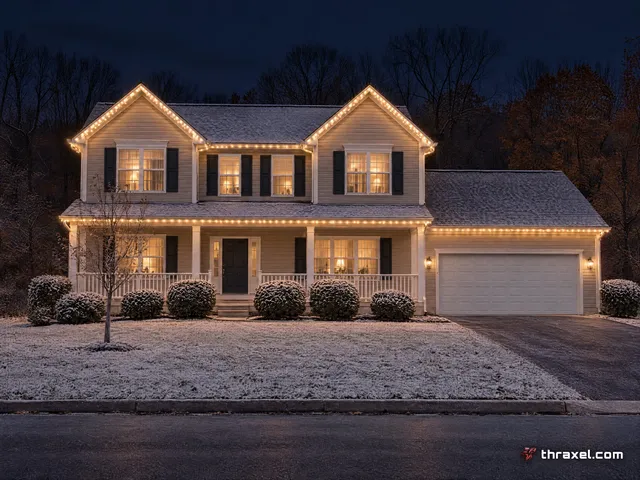
Beyond the presets, you can pick which pixels do what. Light only the peaks of a colonial in color and keep the eaves warm white. Run a pattern across the garage and leave the front door plain. Sync the whole thing to music for a July party on the patio. An addressable line does not have a fixed look, it has whatever look you set that night.
- Patterns: alternating, chasing, fading, breathing, music-synced
- Sectioning: colors on the peaks, warm white on the runs, or the reverse
- Zones: roofline, soffits, columns and fence line addressed separately or together
Why it changes repairs
Here is the part that saves you money over years. Because each pixel reports on its own address, a failed one is identified individually. There is no testing a strand bulb by bulb in January wind. We know which pixel it is, we come out, we replace it, and the run is whole again, typically the same day.
Old series-wired string lights had the opposite behavior: one bad bulb could take down a whole section, and finding it meant pulling every socket. Addressable pixels fail alone and get fixed alone. Combined with the 3-year parts warranty, it means a single bad diode never becomes a dark roofline for the season.
Where the address lives and why placement matters
Addresses are assigned by physical position along the wire, which is why install order matters. Our crew lays the track so the data flows in a logical path around the house, and the design mock-up you receive within 24 hours shows the zones in that order. Move a section later and the addresses shift, so we plan the path once and get it right.
This is also why a permanent install is not a DIY strip from a hardware store cut to fit. A consumer strip may be addressable, but without a controller that knows the layout of your house, the peaks, the returns, the garage bump-out, it is just a line of lights that all do the same trick.
Addressable pixels and power
Each addressable RGBWW pixel draws roughly 0.3 watts. A typical 168-LED install running six hours a night runs about $52.80 a year in electricity. Addressing does not add meaningful draw; the chip inside each pixel sips a trivial amount, and the color diodes only pull power when they are actually lit.
On a warm-white night the three color diodes are off and only the white diode is working. On a Halloween night the reverse. The controller and 16-gauge wire are sized for the full count so the last pixel on the run is as bright as the first.
The takeaway
When you compare permanent lighting quotes, addressable is a word to look for, and it should be paired with RGBWW and individual pixel diagnosis. A system without individual addressing is a colored light bar. A system with it is a display you control from the couch.
We show this live at every free consult with a demo case of four addressable RGBWW strips. Book at thraxel.com/quote/, or text Thraxel at 724-859-4390 and tell us which street you are on. If you are anywhere near thraxel.com/areas/kittanning/, every 16xxx ZIP is on our daily route.