Landscape season
Spring is when Western PA yards come back to life after dark
Once the frost breaks, landscape lighting projects in Western PA pick up fast. Firepits, patios and paths that sat dark all winter are worth wiring before the season's first evening outside.

Why spring is landscape lighting's busiest stretch
Once the ground thaws enough to run wire and set fixtures, landscape lighting installs are back on. Unlike permanent roofline systems, landscape work depends on soil condition as much as air temperature, so spring is genuinely the season it wakes up in.
That distinction matters for anyone comparing landscape lighting to a permanent roofline install. Roofline track mounts to a fascia that doesn't care much about frost, while a fixture that needs to be set into the ground genuinely can't go in until the soil cooperates.
It also lines up with when people start actually using their yards again. A firepit or patio that has been dead space since October becomes worth lighting the moment it's back in the evening rotation, which is exactly what happens in April and May.
There's a scheduling overlap worth knowing about too. Spring is also when permanent roofline installs restart, so a property considering both projects at once should expect the calendar to be busier than in the dead of winter, another reason to request a consultation before the season is in full swing.
What a spring landscape project typically covers
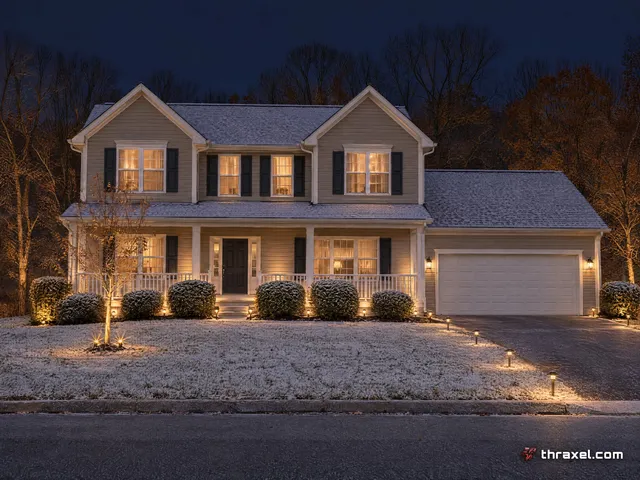
Full landscape lighting design covers firepits, pool decks, patios, trees, path lighting, the house exterior itself, docks, fence lines and signage. Spring projects tend to focus on the zones people gather in first, paths and patios, with tree and facade uplighting often following once the rest of the property is settled.
Fixtures run from warm white through full RGB color-changing, so a path light and a tree uplight can share a system without matching each other exactly. See thraxel.com/landscape/ for the full range of what gets covered.
Waterfront properties get their own spring push too. A dock that sat unused all winter is one of the first things reconnected once the weather turns, and marine-rated fixtures built for sitting over water make that a natural spring project alongside the more common patio and path work, especially along the Allegheny and the region's lakes.
- Path and walkway lighting for spring foot traffic
- Patio and firepit lighting for evening gatherings
- Tree and facade uplighting once the core zones are set
Why astronomical timers matter for a spring install
Spring daylight changes fast, sunset shifting by close to an hour over just a few weeks. Astronomical timers adjust automatically with the season, so a system set up in April keeps turning on at the right time in June without anyone touching a dial.
That matters more for a spring install than any other season, since the daylight swing is steepest right when the system is brand new and homeowners are least likely to think about resetting a manual timer.
It also means a homeowner who installs in April doesn't have to think about the system again until something actually needs attention. The lighting simply comes on a little later each week as the season moves toward summer, matching real sunset instead of a fixed clock time someone set once and forgot about, which is exactly the point of automating it.
Permits happen before the shovels do
Landscape lighting installs are permit-aware from the start, meaning any required paperwork gets handled before ladders or shovels come out. Spring is a common season for other yard projects too, so coordinating permits early avoids a landscape lighting install running into a separate permit process it didn't need to.
That paperwork step is one reason a spring request made in late winter has an advantage over one made once the ground has already thawed. Any permit that needs approval has time to clear before the crew is standing in the yard ready to work, rather than sitting on hold once the fixtures and wire are already on site.
What a full landscape project can look like at scale
One featured residential install covered three zones with 68 fixtures across more than 1,000 feet of run, drawing 330 watts total. Not every property needs that scale, most spring projects are smaller and more targeted, but it shows how far a landscape system can extend once path, patio, tree and facade lighting are all tied into one design.
Annual preventive maintenance is available for systems that size or larger, along with service plans for anyone who wants to keep the whole layout running without checking on it fixture by fixture.
A design that size also benefits most from astronomical timing, since a layout that large is running a lot of fixtures across a lot of zones every evening, and manually adjusting each one as sunset shifts through spring simply is not practical. The same logic applies to smaller residential systems, just at a lower stakes level.
Getting a spring project on the calendar
The process starts with a free consultation and a render of the actual property, the same as any other Thraxel project. Spring fills quickly once the ground thaws, so a request in late winter tends to land the earliest install slots. Start one at thraxel.com/quote/.
Most residential landscape projects install within one to two days once scheduled, the same general timeline as a permanent roofline system, though a larger multi-zone layout like the featured install can run longer depending on scope. Crews are fully insured and every fixture is UL, ETL or CUL certified, no matter how small or large the project ends up being.