How it's controlled
What astronomical timers are and why every landscape system should have one
A fixed timer turns lights on at 6pm sharp, whether it is June or December. An astronomical timer calculates actual sunrise and sunset for your exact location and adjusts every single day, automatically.

The problem with a plain timer
A standard timer runs on a fixed schedule you set once and forget. That works fine for a week or two, then the days get shorter or longer and the lighting stops matching reality: coming on while it is still light in June, staying dark for an hour after sunset in December.
Most homeowners with a plain timer end up adjusting it two or three times a year just to keep up, and most of them forget, which is how you end up with a roofline going dark while it is still visibly dusk outside.
It is a small annoyance in isolation, but it compounds. A landscape system with a dozen zones on separate plain timers means a dozen separate adjustments every time the seasons shift, and most households simply stop bothering after the first year.
How an astronomical timer actually works
An astronomical timer is programmed with a property's latitude and longitude and calculates the real sunrise and sunset time for that exact spot, every single day of the year, without anyone touching it. The lighting schedule shifts gradually with the seasons instead of jumping on a fixed clock.
It is the standard control method for landscape lighting zones, and it removes an entire category of homeowner maintenance. Nobody has to remember daylight saving time changes or manually push a schedule back two minutes a week through late fall.
Some systems also allow a small offset, a few minutes earlier or later than true sunset, for homeowners who want lights on slightly ahead of dusk for guests arriving or slightly later for energy savings. The underlying calculation still handles the seasonal drift automatically either way.
Where it fits with the rest of a lighting system
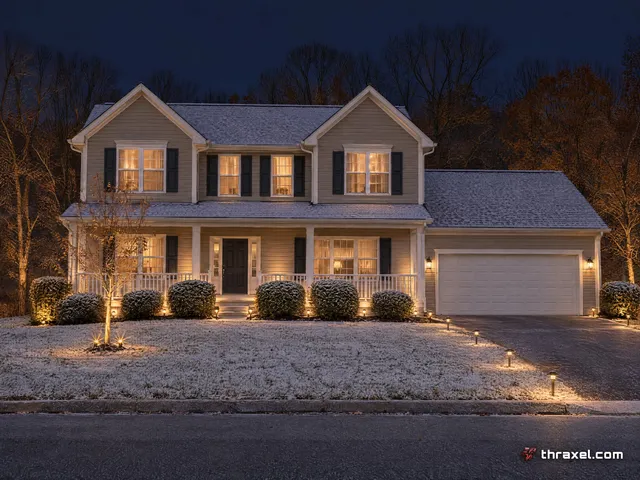
Landscape zones like paths, trees and facades typically run on astronomical timing by default, since those zones are meant to be on from dusk to a set cutoff, not manually triggered every night. Roofline permanent lighting works differently, with scene changes run from the Thraxel Lighting app for occasions like a holiday or game day.
The two systems complement each other on a full property: astronomical timing handles the predictable, everyday on-off cycle, while app control handles the moments a homeowner actually wants to change something.
A homeowner does not have to choose one control method for an entire property. It is common to have astronomical timing running quietly in the background on landscape zones while the roofline gets manual scene changes for the Fourth of July or a Steelers game.
Why it matters more in Western PA specifically
Daylight swings hard here across the year, from roughly 15 hours of daylight in June down to around 9 in December. A fixed timer set correctly in July would have a roofline dark until well after dinner by the time winter hits, or running for hours before it is actually dark in summer.
An astronomical timer tracks that full swing automatically, which matters more the further the seasons stretch apart, and Western PA's seasons stretch about as far apart as they get in the lower 48.
River valleys and hillier terrain around Kittanning and Butler County can also shift local sunset slightly earlier than a flat, open property nearby, which is another reason a timer calculated for the exact site, not a regional average, matters.
Setting one up
Astronomical timers are configured once, at install, using the property's exact coordinates, and then they run without further input. If a homeowner wants a manual override for a specific night, that is still possible, it just is not the default behavior.
It comes standard on landscape lighting installs and can be reviewed on any Thraxel walkthrough. Reach out at thraxel.com/quote/ to get a system scoped for your property.
Power outages, common during a Western PA storm, can occasionally reset a controller's clock, which is one of the small checks included in an annual maintenance visit rather than something a homeowner has to catch on their own.
Common misconceptions about how timers work
A common assumption is that an astronomical timer needs Wi-Fi to function day to day, but the core calculation runs locally off the programmed coordinates, not a live internet connection. Connectivity matters more for remote scheduling and app control than for the basic sunrise-sunset math itself.
Another misconception is that astronomical timing means a system cannot also be turned off manually for an occasion, a late-season storm, a night nobody is home to see it. Manual override is still available on top of the automatic schedule, it simply is not the everyday default behavior.
Some homeowners also assume every zone on a property needs identical timing, when in practice a front walk, a back patio and a dock can each run on slightly different schedules depending on how and when that specific area actually gets used.
It is also a misconception that astronomical timers are only for large, complex properties. Even a single-zone front walk benefits from the same accurate sunrise-sunset calculation as a full multi-zone system, and it is the default control method regardless of how small the install is.
Commercial properties with entrance and plaza lighting rely on the exact same principle at a larger scale, since a restaurant or office park needs its lighting on before the first evening customer arrives regardless of the season, without staff having to remember to flip anything by hand, and without a bright afternoon sky burning power for hours nobody needed it lit.