Landscape 101
Landscape lighting basics for Western PA yards
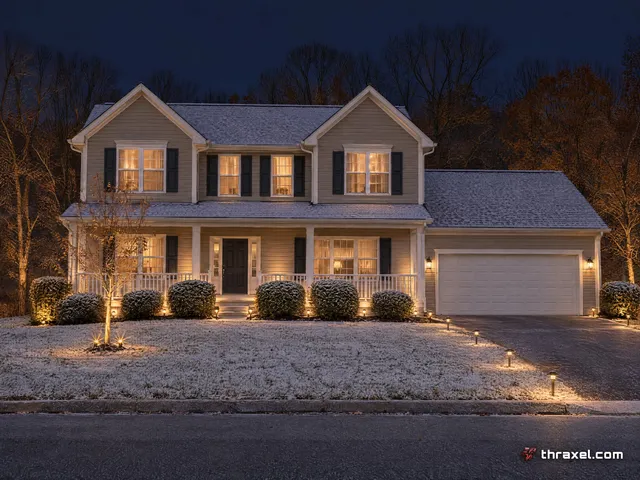
Landscape lighting is everything below the roofline: trees, paths, pools, patios, docks and facades. It is a separate system from roofline lighting, priced and designed on its own. Here is what actually goes into a Western PA yard.

What counts as landscape lighting
Landscape lighting is any fixture that is not on the roofline. Trees, walkways, pool decks, patios, docks, fence lines, signage and stone or brick facades all fall under it. Thraxel designs the whole property as one system rather than treating each zone as a separate add-on.
It runs on warm white or full RGB color-changing, depending on the fixture and the zone. A front walk usually stays warm white year-round. A patio or pool area sometimes gets color for a party or a holiday, then goes back to warm white the next morning.
A recent residential job we tracked put this in perspective: three zones, 68 fixtures, 330 watts of draw across more than 1,000 feet of run. That is a full-property system, not a few spike lights from a hardware store, and it is closer to what most homeowners end up with once they see the full plan laid out.
The goal on any consult is the same regardless of scale: figure out what a property actually needs lit, not what fills the most invoice lines. Some yards genuinely need three or four fixtures near the front door and nothing else.
The zones a typical yard covers
Most Western PA properties break into a handful of repeatable zones. You do not need all of them at once. A first phase often covers the front of the house and the walk, with trees and the back patio added later.
Every zone gets its own fixture count and its own reason for being lit, which is why a walkthrough with an installer matters more than a generic online estimate. A front bed near a busy road needs a different plan than a wooded back lot with no street visibility at all.
Phasing is common and expected. A homeowner might light the front entry and driveway one year, then add the patio and a few feature trees the next, building toward the full property over two or three seasons instead of one large invoice.
- Front foundation and entry beds
- Trees and specimen plantings
- Paths, steps and driveways
- Pool decks and patios
- Docks and fence lines
- Stone, brick or signage facades
Warm white, color, or both
Warm white is the default for landscape fixtures because it reads as natural moonlight and does not fight with a brick or stone exterior. Most Western PA homeowners run warm white the vast majority of the year and add color only for specific occasions.
Color-changing RGB fixtures cost more per point but give a pool deck or patio a different mood for a graduation party, a Steelers game, or a July evening without touching a bulb. thraxel.com/landscape/ covers which zones make sense for each option.
A common pattern on Thraxel designs is warm white on every functional zone, paths, driveways, most trees, with color reserved for one or two zones a homeowner actually entertains in. That keeps cost focused where it gets used rather than spread evenly across a property.
Timers, permits and the parts nobody sees
Landscape systems run on astronomical timers that shift on and off times with sunrise and sunset automatically, so nobody resets a clock twice a year. Annual preventive maintenance and ongoing service plans are available once a system is in.
Fixtures near a property line, an easement or a shared dock sometimes need a permit before anyone digs. Thraxel handles that paperwork ahead of the install so ladders and shovels do not go out until the job is cleared.
National industry estimates commonly put landscape fixtures at roughly $150 to $400 installed per fixture, which is a wide range because a spike light in a mulch bed and an in-ground well light under a mature oak are different jobs. Your property is what sets the real number, which is why the on-site quote is free.
Wiring is run on 16-gauge outdoor-rated wire, buried at a proper depth rather than laid across the surface of a bed, so a system holds up under mowing, mulching and normal yard traffic instead of becoming a tripping hazard or a weed-whacker casualty in its first season.
How a project actually gets planned
A landscape consult starts with a walk of the property, in daylight and sometimes back at dusk, to see how the beds, trees and hardscape actually sit relative to each other. From there Thraxel builds a zone-by-zone plan rather than a single lump-sum guess.
Because it is fully insured work with UL, ETL and CUL certified components, the same crew standard applies here as on a roofline job. Text or call Thraxel at 724-859-4390 to get a date on the calendar for a walkthrough.
Financing at 0% APR for up to 24 months is available for qualifying buyers, which is worth asking about if a full-property plan is more than a single season's budget can absorb comfortably.
What comes after the install
A finished landscape system gets a walkthrough where the homeowner sees every zone lit and confirms it matches what was planned. From there, annual preventive maintenance keeps aim, connections and brightness consistent through the freeze-thaw cycles a Western PA yard goes through every winter.
Most homeowners who start with a small first phase come back within a season or two to add the next zone once they see how the first one changes how the property looks and gets used after dark.
How landscape lighting pairs with the rest of the property
A lot of Western PA homeowners come to landscape lighting after already having permanent roofline lighting installed, once they see how much a lit roofline changes the way the rest of the property looks by comparison. The two systems are quoted separately but designed to sit together visually.
The reverse order works too. Some properties start with landscape lighting, a patio or a set of trees, and add roofline lighting later once the household has lived with the first system and knows how much they want to expand.
Either way, thraxel.com/permanent/ and thraxel.com/landscape/ are worth reading side by side if you are trying to figure out where to start on a property that currently has neither.