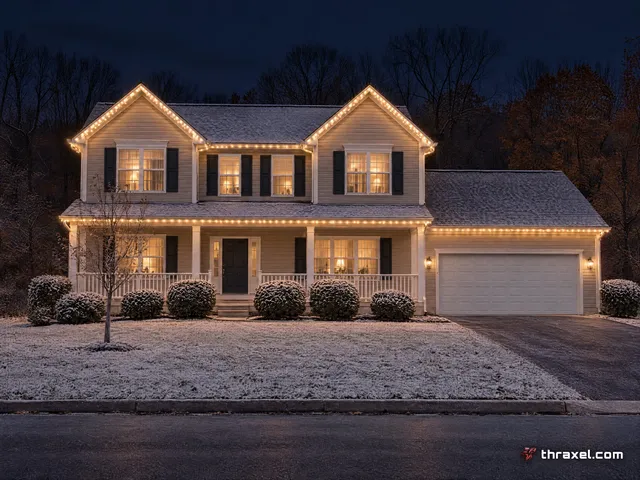
Under the snow
Snow load and exterior lighting: what holds up and what does not
Snow load is the weight of accumulated snow pressing on whatever it lands on. On a roofline it pushes down, slides sideways and lets go all at once. On a lawn it buries fixtures for weeks. Here is how each part of a lighting system handles that weight.

Not all snow weighs the same
Dry powder from a cold front is light and blows off a roof edge on its own. The wet stuff that falls in the Allegheny valley when the temperature hovers at 31 degrees is a different animal. It is dense, it sticks to every surface it touches, and a few inches of it on a roof edge can weigh more than a foot of powder.
That wet snow is what we plan for in Kittanning, Butler and Clarion. It piles on the gutter lip, bridges across anything mounted near the eave, and then, when the sun hits it, slides as a single slab. The slide is where most of the damage happens, not the sitting.
Further north toward DuBois and the snowbelt, totals go up and the snow tends to be drier, which trades weight for volume. Both matter. A lighting system has to survive being loaded, being buried and being hit by moving snow, sometimes in the same afternoon.
Where snow actually lands on a lighting system
Three places. The roof edge, where roofline lighting lives. The ground, where path lights, uplights and wire runs sit. And the trees, where wrapped trunks and branches carry lights that were never designed to hold a load of their own.
Roofline hardware sees the worst of it because it is the last thing snow touches on the way off the roof. Ground fixtures mostly get buried, which sounds bad but is usually harmless. Tree wraps see the widest variety: snow weight bending branches, ice glazing the wire, and limbs dropping when the load gets too high.
The question for each is the same. When the snow arrives, does the hardware move, or does it stay put? Anything that moves under load eventually fails.
Why continuous track beats clips under load
Permanent roofline lighting rides inside a color-matched aluminum extrusion that is fastened along its full length to the fascia. Snow sitting on the roof edge bears on the shingle lip and the gutter, not on the track, which is tucked underneath and behind that edge. When the slab slides, it passes over the top of the track rather than through it.
Clip-hung C9 strings sit on top of the shingle edge or the gutter, directly in the path of the load. Every clip is a separate small point of failure, and a slab of wet snow sliding off a roof will take the whole line with it. This is the mechanical reason we moved from clips to track as the standard for anything meant to stay up.
The pixels themselves add no weakness. The silicone housing carries an IP67 rating, so being buried in slush is a non-event, and the 16-gauge wire has enough strength that a snow slide dragging across it does not stretch or sever the conductor. Full component list at thraxel.com/permanent/.
- Track fastened continuously, so load is spread rather than concentrated on clips
- Mounted below the roof edge, out of the slide path
- IP67 silicone pixels that do not care about being buried
- 16-gauge conductor that survives a slab passing over it
Landscape fixtures under two feet of snow
A buried path light keeps working. The lens glows through a few inches of snow and goes dark under more, but the fixture itself is sealed and the snow is actually insulating it from wind and ice. The thing that breaks landscape lights in winter is not snow, it is a plow blade or a snowblower.
So placement is the whole game. We keep fixtures out of the driveway plow path, off the edge of walkways where a shovel will hit them, and away from spots where a roof valley dumps a slide onto the lawn. Wire runs are buried, splices are sealed, and the transformer sits somewhere the drift will not reach.
If a fixture does get clipped by a plow, that is a physical strike and not a weather failure. It is also a quick swap during the spring visit under a service plan. The basics are covered in our landscape overview at thraxel.com/blog/landscape-lighting-basics-western-pa/.
Metal roofs and the avalanche zone
Standing-seam metal roofs are common on newer homes and cabins across the region, and they shed snow in one violent motion. Everything below the drip edge is in the avalanche zone. We can and do light metal-roofed homes, but the track placement changes: tighter to the fascia, sometimes on a lower trim line, and never on a gutter that is going to take the hit.
Snow guards, the small brackets that break up a slide, help the lights as much as they help the porch below. If your roof has them, we work around them. If you are adding them, do it before the lighting install so we can plan the run against the final roof.
The same logic applies to lower roofs under a valley. Where a second-story roof dumps onto a first-story eave, that lower run takes a beating every storm. We route around the worst of it or reinforce the mount, and the render shows exactly where.
Seasonal lights and snow days
Our seasonal Christmas crews only install when the weather allows. Hanging C9 strings onto a snow-covered roof edge is a safety problem and a quality problem, so a snowy November week pushes the schedule rather than the standard. That is one reason the dry November weekends fill first.
Once seasonal lights are up, snow damage is ours to fix. A string pulled down by a slide gets rehung within 24 to 48 hours at no charge, all season long. You do not go out with a broom.
Before the first real snow, we suggest one thing to every customer with either system: walk the perimeter after the storm and look up. If a section is dark or a string is hanging, send Thraxel a photo at 724-859-4390. Most of the time everything is fine, and knowing that beats wondering.