The snowbelt
Lake-effect snow and exterior lighting on the Erie shore
Lake-effect snow is what happens when cold air crosses a warmer Lake Erie, loads up on moisture, and dumps it in narrow bands over the first land it reaches. Erie and the I-90 corridor into New York live under those bands from November to March. Lighting up there has to be built for it.

What makes lake-effect snow different
Inland snow in the Allegheny valley comes from a storm system and falls more or less evenly across the region. Lake-effect snow comes from the lake itself. Arctic air moving over open water picks up heat and moisture, rises, and drops it as snow in bands that can be a few miles wide. One township gets two feet while the next gets flurries.
The bands persist as long as the wind direction holds and the lake stays unfrozen. Early in the season, before ice cover forms, that can mean days of continuous snowfall. Erie regularly ranks among the snowiest cities in the country, and the totals climb further along the shore into Chautauqua County and Jamestown.
For a lighting system the practical differences are volume, wind and repetition. More snow, more often, pushed sideways by a steady northwest wind off the water.
Roofline lighting under a snowbelt winter
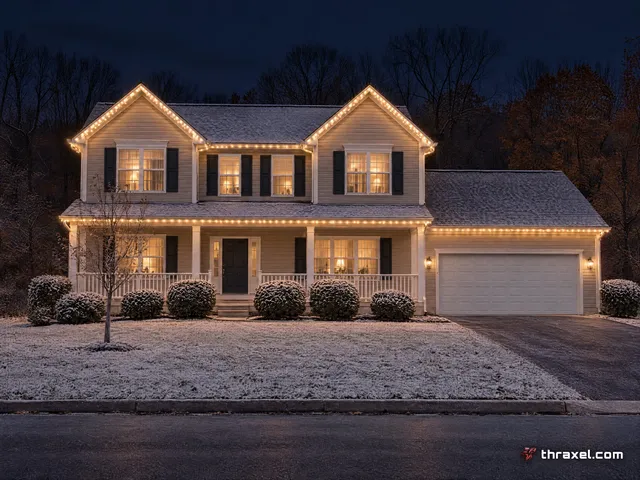
Thraxel permanent lighting mounts to the fascia inside a color-matched aluminum track, tucked under the roof edge. In Erie that placement does something specific: it keeps the pixel run out of the drift that forms along the gutter line when wind stacks snow against the house. The lights sit behind and below the accumulation, not in it.
When drifts do climb the fascia, the lights keep working under them. The pixels use IP67 marine-grade silicone encapsulation on 16-gauge wire, so being packed in snow for a week is neither a moisture problem nor a strain problem. A few inches of cover still glows through. Deeper cover simply hides the run until it melts or slides.
Sliding is the event to plan for. Snowbelt roofs shed enormous slabs, and the track is positioned so those slabs pass over it. We covered the mechanics of that in detail at thraxel.com/blog/snow-load-and-exterior-lighting/.
- Track sits under the roof edge, outside the drift zone along the gutter
- Sealed pixels keep working when buried
- Continuous aluminum channel shrugs off slab slides
- Nothing to remove, restring or rescue between storms
Landscape lighting under three feet of snow
Path lights and uplights near the lake spend long stretches of winter completely buried. That is fine for the fixture. The sealed housing does not care, and the snowpack actually shelters it from wind and freezing spray. What matters is where the fixture stands relative to the snowblower, the plow and the roof slide.
In Erie we keep fixtures well back from driveways and walkway edges, because a snowblower running the same path every morning for four months will eventually find anything within a foot of it. Uplights on trees go on the lee side where possible. Wire is buried and every splice is sealed.
A lit house on a dark lakefront street in January is a striking thing, and the landscape layer is what makes it look finished rather than outlined. We plan that layer knowing it will disappear for weeks at a time and come back in March exactly where we left it. Landscape options are at thraxel.com/landscape/.
Shoreline ice and freezing spray
Homes close to the water get a hazard inland homes never see: wind-driven spray that freezes on contact. Before the lake ices over, a northwest gale throws water across the shoreline, and it coats everything it reaches in a shell of ice that can be several inches thick. It is heavy, it is corrosive, and it is relentless.
This is where the salt-tested rating on the pixels earns its place. Lake Erie is fresh water, but the corrosion problem is the same: constant wet, constant freezing, and road salt tracked in on the spray from the nearby streets. Silicone does not corrode and aluminum does not rust, so the system is not fighting its own materials through the winter.
Track fastened along its full length holds under ice shell weight in a way that individual clips cannot. We wrote up the corrosion side at thraxel.com/blog/salt-tested-lighting-explained/ for river and lake homes alike.
Why permanent beats seasonal in the snowbelt
Seasonal Christmas lights in Erie are a scheduling problem before they are a durability problem. The install window in November is short and the weather turns fast, and once the bands start, a crew cannot safely work a roof edge for days at a time. Then the strings spend December buried, and takedown in January is a dig.
A permanent system is installed once, in good weather, and never comes down. Christmas, Halloween, the Fourth and game day all run from the Thraxel Lighting app, and the Everyday Warm scene handles the other 300 nights. Nobody goes up a ladder in a lake-effect band to fix a clip.
That is the honest reason we recommend permanent over seasonal for lakefront homes more strongly than for homes in Kittanning. The winter is simply harder on anything temporary.
The drive from Kittanning
Erie is about 130 miles and two and a half hours north of us. It is inside the Pennsylvania footprint we cover, and every 16xxx ZIP is on the daily route. We have installed there, and one of those jobs is the one we cite most: an Erie colonial with 312 feet of roofline across 6 zones appraised $42,000 higher afterward, and two neighbors on the street signed the same season. Directional, not guaranteed, but real.
The process is the same as anywhere else. A free on-site consultation with the demo case on your driveway, a design mock-up of your actual house within 24 hours, and most homes installed in one or two days. Our Erie page is at thraxel.com/areas/erie/, and Jamestown across the state line is on the same route.
If you are up on the shore and tired of what lake winters do to temporary lights, Tyson quotes every job himself. Call or text 724-859-4390.