Voltage basics
Low-voltage vs line-voltage exterior lighting, and why it matters
Landscape fixtures and a home's roofline system are not always wired the same way. The voltage difference changes what is safer to touch, what a permit needs, and how a job gets run.

What the terms mean
Line voltage is the standard household electrical current running through a home's wiring, typically 120 volts in a US residential setting. Low voltage is a stepped-down current, commonly 12 volts, run through a transformer before it reaches a fixture.
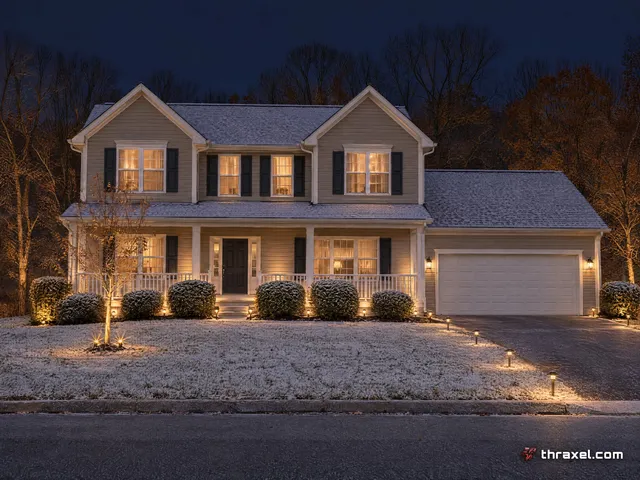
Most residential landscape lighting, path lights, tree uplights and similar fixtures, runs on low voltage. A permanent roofline system and a home's general electrical circuits typically run on line voltage feeding into the lighting controller.
The distinction is about how power gets delivered to a fixture, not about the light quality or color range the fixture can produce. Both voltage types can drive modern LED and RGBWW lighting.
Why landscape lighting favors low voltage
Low-voltage wire is safer to bury shallow, easier to run across a yard without deep trenching, and more forgiving if a shovel or a dog eventually finds it. That combination is why landscape fixtures, path lights and tree uplights generally run on low voltage rather than full household current. See thraxel.com/landscape/ for how a full landscape lighting plan is designed.
A low-voltage transformer steps power down before it reaches the outdoor run, so what is actually threading through the yard is a much lower-risk current than what runs inside the walls of the house.
This matters most on properties with kids, pets, or a landscaping crew that regularly digs near fixture runs, since a low-voltage line accidentally nicked by a shovel carries far less risk than a line-voltage circuit would in the same spot.
Why a roofline system runs differently
A permanent roofline system connects into a home's line-voltage electrical supply through its controller, since it needs to power potentially hundreds of pixels across a long run of track. The wiring specific to the lighting itself is built for exterior exposure regardless of which voltage feeds it, using IP67 marine-grade housing on 16-gauge wire.
This is standard for the category, not a Thraxel-specific design choice. Any permanent roofline lighting product on the market handles power this way because of the scale of a full-house install.
The controller is where line voltage from the house meets the lower-voltage signal driving the individual pixels, so the conversion happens once at a single, protected point rather than at every fixture the way a landscape run would handle it.
What this means for permits and safety
Line-voltage work generally falls under stricter code and permitting requirements than low-voltage landscape wiring, since it carries more electrical risk if handled incorrectly. Permit-aware installs account for this before any ladder goes up, handling the paperwork so a homeowner does not have to.
Low-voltage landscape work still deserves a professional install for placement, waterproofing and transformer sizing, even though the electrical risk profile is lower than line-voltage work. See thraxel.com/blog/electrical-safety-for-outdoor-lights/ for more on how both categories are handled safely.
What this means for cost and planning
Voltage type is one of several factors that shapes a quote, alongside fixture count, run length and permit requirements specific to a township. It is not something a homeowner needs to specify themselves, since the right voltage is determined by what kind of lighting is going in and where.
A property running both a permanent roofline and landscape lighting ends up with both voltage types on site at once, each doing the job it is built for. More on what drives overall project cost is at thraxel.com/blog/what-drives-permanent-lighting-cost/.