Price anatomy
What actually drives the cost of permanent lighting
Linear feet of track is the number that sets your price. After that it is peaks and returns, how high the crew has to work, how many zones you want, and how much power the run needs. Colors, scenes and the app do not move the total.

The answer up front
Every permanent lighting quote we write in Western PA comes down to five inputs. How many feet of track go on the house. How many peaks, valleys and returns that track has to negotiate. How high the fascia sits off the ground. How many separate zones you want to control. And how much power has to be injected along the run to keep the last pixel as bright as the first.
National industry estimates commonly put permanent roofline systems between roughly $20 and $50 per linear foot installed. That is a wide band on purpose. A single-story ranch in Ford City with a straight eave sits near the bottom of it. A three-gable brick colonial in Fox Chapel with dormers and a detached garage sits near the top. Your property will land somewhere specific, which is why the quote is free and done on site.
We do not publish Thraxel pricing on this blog. Every roofline is different and a number pulled from a chart would be wrong for your house in one direction or the other. What we can do is walk you through exactly which parts of your home push the number up, so nothing on the quote surprises you.
Linear feet is the number everything hangs on
Track is sold, cut and installed by the foot, and the pixels ride inside it at a fixed spacing. More feet means more aluminum, more RGBWW pixels, more 16-gauge wire and more crew hours on the wall. A typical two-story home with lighting on the front eaves and the peaks runs a couple hundred feet. Wrapping all four sides, the garage and a porch can double that.
This is where most homeowners over-estimate. Most of our Armstrong and Butler County installs light the street-facing roofline and the visible peaks, not every inch of gutter on the property. The back of the house rarely needs track unless there is a patio or pool you want lit, and that is usually a separate landscape conversation.
The design mock-up we send within 24 hours shows exactly which runs are included. If you want to trim the footage, we redraw it. If you want to add the side elevation later, the controller has room to grow and we come back for a second run.
Peaks, returns and the shape of your roof
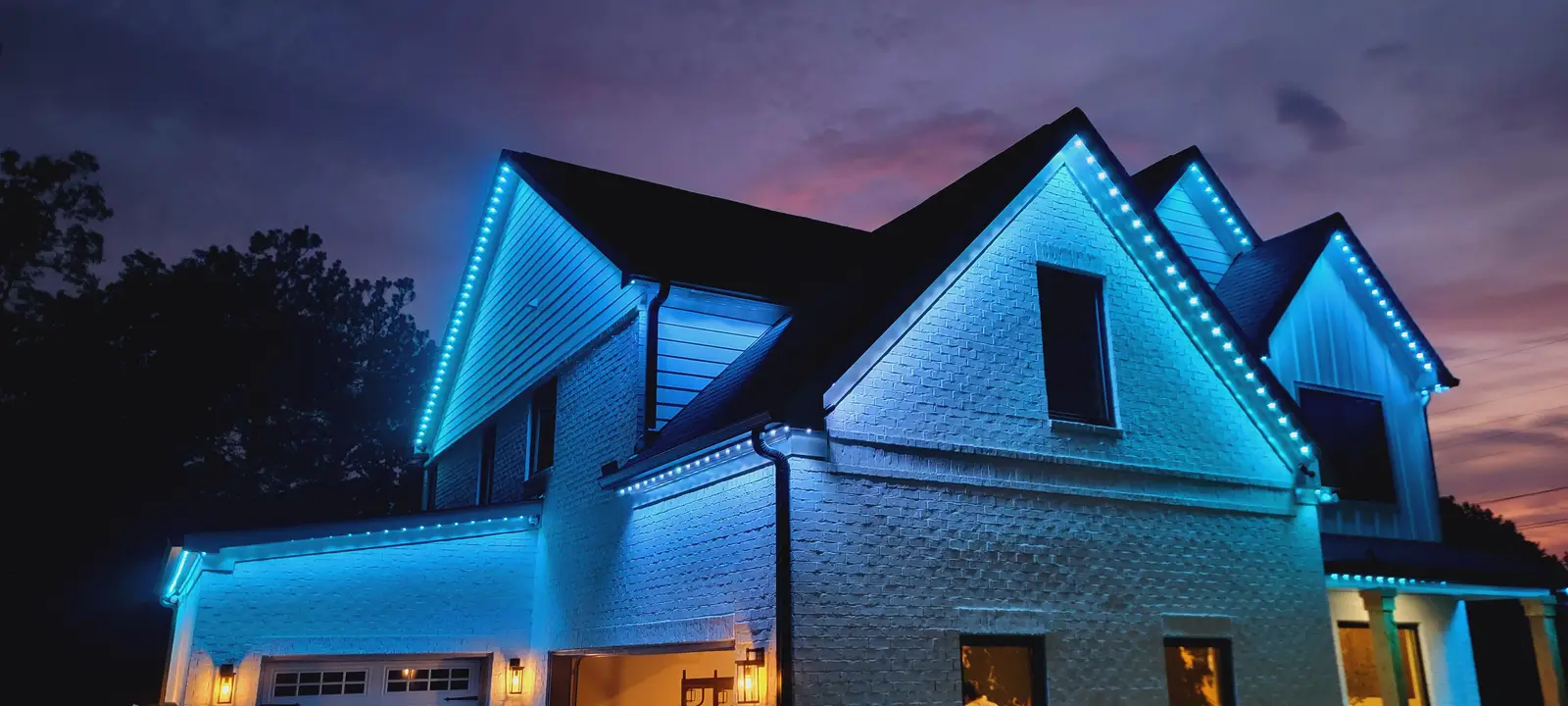
A straight 40-foot eave is one cut of track and a handful of mounting points. A 40-foot section with two gables in it is six cuts, four mitered corners, and a crew member working the peak from a ladder or lift. The footage is identical. The labor is not. Complex rooflines cost more per foot than simple ones, and that is the honest reason the industry range is so wide.
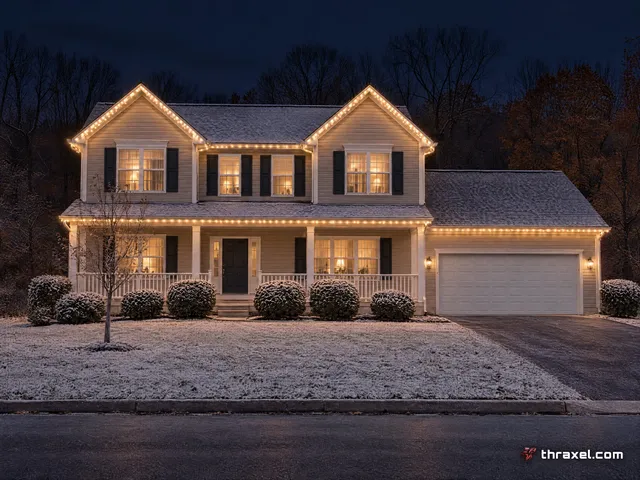
Western PA housing stock makes this matter. The brick colonials and Cape Cods that fill the river towns from Freeport to Tarentum tend to have clean lines and a couple of dormers. The newer builds in Cranberry and Wexford have a lot of roof geometry, front-facing gables stacked on gables. The second type looks spectacular lit, and it takes more time to do right.
Color-matched track has to sit tight against the fascia to disappear by day, and that fit is the difference between a system that passes an HOA review and one that gets flagged. We do not cut corners on corners.
- Simple: single-story eave, one or two peaks
- Moderate: two-story front elevation, three to five peaks, a porch roof
- Complex: multiple stacked gables, dormers, turrets, a detached garage or barn
Height, access and where the ladders go
A one-story roofline can be installed from a step ladder and a walk board. A three-story Victorian in Butler needs a lift or a tall extension ladder set on uneven ground, and everything slows down when a crew is working 30 feet up. Steep pitches, slate roofs, and landscaping that keeps a ladder from sitting flat all add time.
Access also includes where the controller and power supply can live. If there is an outlet in the garage near the roofline, wiring is short. If the closest power is on the far side of the house or inside a finished basement, we run more cable and sometimes bring in an electrician for a dedicated outlet. That shows up as a line on the quote, not a surprise after the fact.
This is also where you are paying for safety. Our crews hold manufacturer-required install certifications, wear proper PPE and are fully insured. A cheaper number from someone without that coverage is a number you might end up paying twice.
Zones, controllers and power injection
A zone is a section of the run you can control independently. One zone means the whole house does the same thing. Six zones means the peaks can run one color while the eaves run another, the garage stays off, and the columns pulse on a Steelers touchdown. Each zone adds a little wire and a little controller capacity, and more zones give the app more to do.
Every pixel draws roughly 0.3 watts, so the electrical load is small, but voltage still drops over long runs. Past a certain length the crew injects power partway along the track so the far end matches the near end. Long wraparound installs need more injection points, which is more wire and a slightly larger power supply.
The controller itself is one unit per home in almost every case. It is what talks to the Thraxel Lighting app, Alexa, Google Home, HomeKit and Control4. You do not pay extra for those integrations. They are part of the system from day one.
What does not change the price
This list surprises people. The 16 million colors are included. The dedicated 2700K warm-white diode is included. Every named scene, Everyday Warm, Game Day, Christmas, July 4th, Halloween, and the ones you build yourself, are included. The app is included. Music sync is included.
The warranty, 3 years on parts and 1 year on labor, comes with every install at no added cost, and the details are on thraxel.com/warranty/. Financing at 0% APR for up to 24 months is available to qualifying buyers through our financing partner, and it does not change the price of the system, it just changes when you pay it.
In other words, the quote is about aluminum, pixels, wire, labor and access. It is not about features. You get the whole system whether your house needs 120 feet of track or 500.
How to get your real number
Request a consultation at thraxel.com/quote/ or text Thraxel at 724-859-4390. Tyson walks the property, measures the actual runs, checks power, and sets the demo case on your driveway so you can see the pixels on your own house before we quote anything. The design mock-up arrives within 24 hours.
If you want to understand the line items once the quote lands, thraxel.com/blog/reading-a-lighting-quote/ breaks down how we lay it out. And if you are trying to decide how much roofline to light before we show up, thraxel.com/blog/how-many-lights-does-a-roofline-need/ is the place to start. The full system spec is on thraxel.com/permanent/.