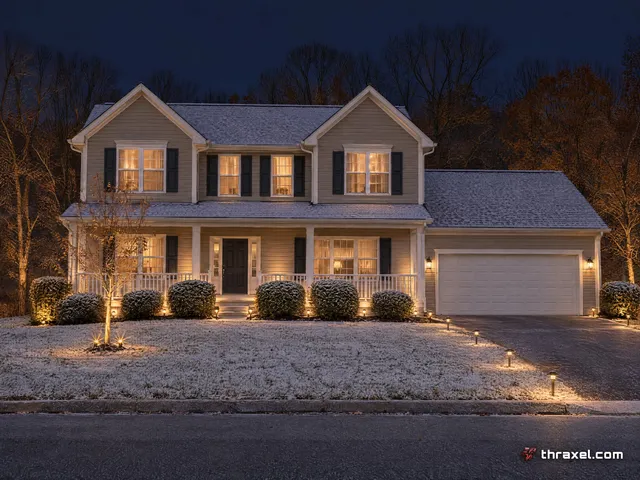
Good neighbor guide
Light pollution, dark-sky etiquette and staying friends with the street
A well-lit house should be noticed from the sidewalk and unnoticed from the neighbor's pillow. Three things get that wrong: glare, light trespass and skyglow. Warm color temperature, careful aiming and a real schedule fix all three, and none of them cost you the look.

What light pollution actually means on a residential street
The term gets used for everything from a porch bulb to a stadium, so it helps to break it into the three parts that matter for a house. Glare is light hitting the eye directly from the source, the fixture you can see rather than the wall it lights. Trespass is light landing on property that is not yours, most often through a bedroom window. Skyglow is light thrown upward, brightening the night sky over the whole neighborhood.
Almost every neighbor complaint we have ever heard about traces to one of those three, and usually to trespass. Nobody minds a lit house across the street. They mind a spotlight that reaches their headboard at midnight.
Dark-sky guidance from astronomy and conservation groups boils down to the same fixes: aim light down and at the surface you want lit, shield the source, keep the color warm, use only as much brightness as the job needs, and turn it off when nobody is looking.
Color temperature is most of the battle
Cool, blue-heavy white light scatters more in the atmosphere and reads harsher to the eye than warm light of the same brightness. That is why dark-sky recommendations consistently favor warm color temperatures around 3000K or lower for outdoor use.
Our permanent pixels carry a dedicated 2700K warm-white diode, separate from the red, green and blue emitters. RGB-only products approximate white by mixing three colors, and the result drifts toward a pale blue or pink that looks off up close and travels farther than it should. A true warm-white diode looks like candlelight on the fascia and stays where it is pointed. The everyday look most of our customers run is described at thraxel.com/blog/everyday-warm-white-scene/.
For landscape work we default to warm white as well, and we save color for the nights that call for it. A green tree in March is fun. A green tree every night is a conversation with the neighbors you do not need to have.
Aim at surfaces, not at people
Roofline lighting is naturally well behaved because the pixels sit inside a channel tucked under the eave, facing outward and slightly down along the fascia. The light source is shielded by the track on three sides. You see a glowing line, not a row of bare emitters, and very little of it escapes upward.
Landscape fixtures need more thought. An uplight under a maple should be positioned so the beam stays inside the canopy and dies out in the leaves rather than continuing across the property line. Path lights should be hooded so the lamp is hidden and the light pools on the walkway. Wall washers should graze the stone, not blast it.
During the final walkthrough we stand where your neighbors stand. If a fixture is visible as a point of light from the adjoining lot or the street, we re-aim it, add a shield, or drop the output. It is a ten-minute check that prevents ten years of friction.
- Uplights: keep the beam inside the tree canopy or on the wall, never past the ridge line
- Path lights: hooded, lamp hidden, light on the ground
- Wall washers: low grazing angle so light stops at the eave
- Floodlights: avoid them entirely on residential lots when a directed fixture will do
- Roofline: run the default scene at a moderate brightness, not full output
Schedules do the quiet work
The single best light-pollution tool is an off switch that works without you. Our landscape systems run on astronomical timers that track sunset and sunrise as the seasons shift, and the permanent roofline system schedules from the app the same way. Set lights on at dusk and off at a reasonable hour, and the neighbors' bedrooms go dark when they do. How the timers work is covered in thraxel.com/blog/what-are-astronomical-timers/.
A sensible residential pattern is dusk to 10 or 11 p.m. for the roofline and landscape, then either off or a very low security level until dawn. On a holiday or a game night you override it from your phone. The rest of the year the schedule protects you from ever becoming the house people talk about.
Flashing, chasing and music-synced effects are the one category to reserve for events. They are fantastic on the Fourth and on Christmas Eve, and exhausting on a random Tuesday. Keep them to occasions and nobody will mind.
Where this matters most in Western PA
Wooded, hilly communities like Fox Chapel and Sewickley sit dark by design, with mature trees, deep lots and a neighborhood culture that likes it that way. Lighting there should feel like it belongs to the house and stops at the tree line. Warm white, low output and downward aim are the whole recipe.
Denser plans in the North Hills and the river towns have the opposite geometry: houses close together, windows facing windows. There, trespass is the concern, and a properly shielded roofline system is often less intrusive than the bare porch floodlight it replaces.
Rural properties in Armstrong, Clarion and Indiana County carry a different responsibility. With no streetlights for a mile, a single over-lit house becomes the brightest object in the valley. Modest output goes a long way when the background is truly dark.
Talk to the street before the street talks about you
Tell the immediate neighbors what is coming. Show them the render, mention the schedule, and ask if any window is a concern. People who were consulted rarely complain, and the ones who had a worry usually tell you exactly which fixture to angle. What to do if a complaint does arrive is covered in thraxel.com/blog/neighbor-complaints-about-holiday-lights/.
A lighting system that respects the block tends to spread down it. In our residential tracking, a neighbor on the same street booked their own install within 18 months on 11 of the last 14 permanent projects, a directional figure and not a promise. Good manners, it turns out, are also good marketing.
If you want a design that looks right from the sidewalk and disappears from the neighbor's bedroom, request a free consultation at thraxel.com/landscape/ and we will aim it that way from the start.