Bulb vs bulb
LED vs incandescent Christmas lights: what you give up and what you get
LEDs win on power, heat, lifespan and safety, and every seasonal display we hang is LED. Incandescent bulbs still hold one card, the warm glass glow some families refuse to give up. This is the honest version of the comparison.

The scoreboard
On almost every measurable line, LED Christmas lights beat incandescent. They use a small fraction of the electricity, run cool enough to touch, survive being stepped on, and last many seasons instead of a few. That is why professional installers across Western PA, us included, hang LED C9 and mini lights exclusively.
Incandescent wins one line, and it is not a small one for some people. The filament inside a glass bulb produces a soft, slightly orange glow with a gentle falloff that early LEDs got badly wrong. If you grew up with that look on a brick house in Latrobe or Indiana, a cold blue LED is not a substitute.
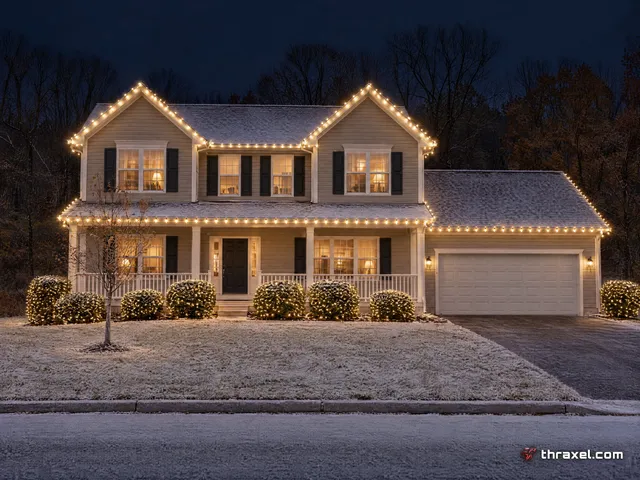
The good news is that the gap on look has mostly closed. Modern warm-white LED C9 bulbs in the 2700K range sit very close to the classic glow, and most people cannot tell from the street. Which brings us to the rest of the comparison.
Power and heat
A traditional incandescent C9 bulb draws roughly 7 watts. A string of a hundred of them pulls around 700 watts, enough to trip a breaker when two or three strings share a circuit with the inflatable in the yard. LED C9 bulbs draw a small fraction of that, which is why a whole LED roofline can run off one outlet without drama.
The energy figure quoted most often is that LEDs use somewhere around 80 to 90 percent less power than equivalent incandescent bulbs. On a December electric bill, that is the difference between noticing the lights and not noticing them.
Heat is the quieter issue. Incandescent bulbs get hot enough to dry out a wreath, soften plastic clips, and in old strands with cracked insulation, start a fire. LEDs run cool. Our safety post at thraxel.com/blog/fire-risk-of-old-christmas-lights/ covers the strands most people should stop plugging in.
Durability and lifespan
Glass incandescent bulbs break. They break in the bin, on the ladder, and when the ice slides off the roof onto them. Filaments also burn out in a way that takes a whole section with them on older series-wired strands. LEDs use a plastic or polycarbonate lens and a solid-state diode with no filament to snap.
Lifespan follows from that. A quality commercial LED strand is rated for tens of thousands of hours and routinely goes many seasons on a roofline. Incandescent sets typically last a few seasons before enough bulbs fail that the strand gets replaced. For a service like ours that stores and rehangs the same lights year after year, LED is the only option that makes the economics work.
The look, honestly
Here is where incandescent still gets a hearing. A filament glow is omnidirectional and slightly warm-orange, with a natural dimness that looks candle-like on a stone home. Cheap LEDs are directional and can look like a row of points instead of a glow. That was the complaint ten years ago and it was fair.
The fix is bulb choice, not technology. Faceted or frosted LED C9 lenses spread the light, and a true warm-white diode gets the color right. When we hang an LED roofline in warm white, the family photos look the way they always did. Our guide at thraxel.com/blog/c9-vs-mini-christmas-lights/ goes into bulb shapes and spacing.
If you hold a lit incandescent C9 next to a lit warm-white LED C9 at arm's length, you will see a difference. From the curb, in the snow, on a house in Johnstown at seven at night, you will not.
Cost, both directions
Incandescent strands are cheaper per box, which is the reason they are still sold. LED strands cost more up front and earn it back through power use and years of service. For a homeowner buying big-box strands for one winter, incandescent can be the cheaper choice on cash. For anyone keeping lights more than a couple of seasons, LED is cheaper overall.
For a professional install the question is already answered. Every strand we hang through thraxel.com/christmas/ is commercial LED, because the in-season repairs are on us, the lights come back to our storage after January 4, and we need them to survive that cycle for years. Seasonal pricing nationally tends to land between roughly $2 and $6 per linear foot. Your home will land somewhere else on that range, and the quote is free.
Where permanent pixels fit in
There is a third option nobody had twenty years ago. Permanent RGBWW pixels live in color-matched track under the eaves year-round, produce a true 2700K warm white plus 16 million colors, and draw roughly 0.3 watts per pixel. A typical 168-LED install costs about $52.80 a year to run at six hours a night, and it does Halloween and the Fourth too.
If the glass-bulb look is non-negotiable, LED C9 on a seasonal program is your answer. If you want the house lit all year without ladders, look at pixels. Either way, Tyson will lay both out on a free consult, reachable at 724-859-4390.