Design ideas
Roofline Christmas lighting ideas that fit the house you already have
The best roofline design follows lines the house already has. Trace the right ones and it looks built-in. Trace the wrong ones and it looks like a strand of lights on a house. Here are the layouts we use most, and what each one suits.

Read the house before you light it
Every house has a few lines that define it and a lot that do not. On a colonial it is the long front eave and the symmetry around the door. On a Cape it is the dormers. On a farmhouse it is the porch roof and the main gable. Roofline lighting works when it follows the defining lines and skips the rest. Lighting every edge you can reach flattens the house into a box.
So the first design decision is subtraction. Which two or three lines make this house recognizable from the road? Those get light. The garage that sits back, the side elevation nobody sees, the low bump-out over the kitchen, those usually do not. The render we send within 24 hours of the consult is where that editing happens, on a screen, before a clip touches a shingle.
Idea one: the full warm-white outline
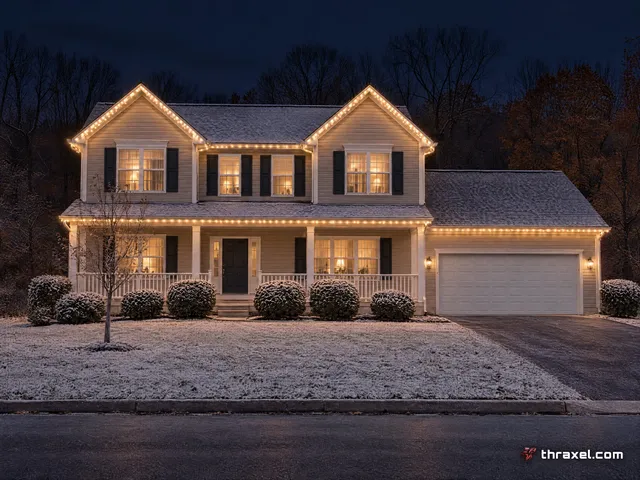
The classic. Warm white C9 along the front eave, up and over every front-facing gable, across the porch roof and along the garage eave if the garage faces the street. It is the design that makes a brick colonial in Butler look like it was drawn for a Christmas card, and it is the one most of our returning customers never change.
It suits homes with strong, simple geometry and a front elevation that faces the street squarely. It suits less well on a house with a jumble of rooflines at different heights, where the outline turns into a tangle. On those, one of the edited versions below usually looks better and costs less.
Idea two: peaks and gables only
Skip the horizontal eaves entirely and light only the triangles: the main gable, the dormer peaks, the porch gable. Each peak becomes a lit chevron floating on the dark roof. It is dramatic, it reads clearly from a distance, and it uses a fraction of the product of a full outline.
This one is made for houses with tall, steep rooflines. A Victorian with three gables, a modern farmhouse with a big front peak, a Tudor in the North Hills with a steep front-facing roof. It is also the design we suggest first when a homeowner wants a professional look on a tighter budget, because the peaks are what the eye lands on anyway.
Idea three: eave plus a single accent
Warm white along the main eave and porch, then one deliberate accent. A red-lit wreath in the center gable. A single spruce in blue. A pair of columns wrapped in warm white minis. Two elements, held apart, look designed. It is restrained enough for an HOA street in Cranberry and still unmistakably Christmas.
The accent can also be the door. A lit garland framing the entry, with the roofline in plain warm white, pulls the eye down to where guests actually arrive. On a ranch, where the roofline is low and close, this bottom-weighted design often looks better than a heavy outline overhead.
Idea four: multicolor tradition, done cleanly
Multicolor C9 along the front eave and gables, nothing else on the roof. The restraint is the trick. When the color lives only on the roofline and the yard stays warm white or unlit, a multicolor house looks intentional instead of chaotic. This is the look on a lot of streets in New Kensington and Lower Burrell, and done right it beats any warm-white house on the block for pure joy.
What we steer people away from is multicolor on the roof plus multicolor trees plus color-changing shrubs plus inflatables. Pick the roofline as the color element and let the rest of the property support it. The color question in full is at thraxel.com/blog/warm-white-vs-multicolor-christmas-lights/.
- Full outline: strong, simple, square-to-the-street homes
- Peaks only: tall, steep, multi-gable homes and tighter budgets
- Eave plus one accent: HOA streets, ranches, anyone who wants restraint
- Multicolor roofline only: tradition without the clutter
Ideas five and six: two-story layering and the garage question
On a two-story home, lighting the upper roofline and leaving the porch roof dark makes the house look like it is floating. Lighting only the porch roof makes it look short. The fix is layering both, with the upper line carrying the outline and the lower line framing the entry. We go deep on tall houses at thraxel.com/blog/christmas-lights-for-two-story-homes/.
The garage is the most-argued line on any consult. Rule of thumb: if the garage door faces the street and sits flush with the house, light its eave to keep the outline continuous. If it is set back or angled away, leave it dark so the house stays the focus. The render settles it in about ten seconds.
Idea seven: make the roofline permanent
Every layout above can also be done once, for good. A permanent system puts RGBWW pixels in color-matched aluminum track tucked under the fascia, invisible by day, and then runs any of these designs from an app. Full warm-white outline in December, peaks-only in red for Valentine's, black and gold for a Sunday in October, and off the rest of the time.
It costs more up front than a seasonal hang, financing at 0% APR for up to 24 months is available for qualifying buyers, and it is not the right move if the fascia is getting replaced next spring. For a house you plan to keep, it is the roofline design that never needs a ladder again. The seasonal and permanent versions are both at thraxel.com/christmas/ and thraxel.com/permanent/, and Tyson quotes either one for free at 724-859-4390.