Gusts and fronts
Wind, storms and why the track does not move
Wind does not damage a lighting system so much as find whatever was loose already. A string on plastic clips has hundreds of loose points. A continuous aluminum track fastened to the fascia has none. That difference is the whole story of storm durability.
The wind we actually get
Western Pennsylvania is not tornado country, but it is front country. Cold fronts sweep through every week from November to April, and the leading edge of each one brings a few hours of gusts that come from a different direction than the last. The river valleys make it worse: the Allegheny, the Kiski and the Conemaugh act like funnels, and homes on the ridges above them sit fully exposed.
Summer brings the other kind. Thunderstorms build over the Laurel Highlands and roll west into Westmoreland County with straight-line winds, hail and a lot of water in a short time. Every few years a stronger line comes through and takes down trees along the Route 22 corridor from Murrysville to Greensburg.
So the design question is not whether the lights will see wind. They will. It is what the wind can get hold of.
Why clip-hung strings are the first thing to go
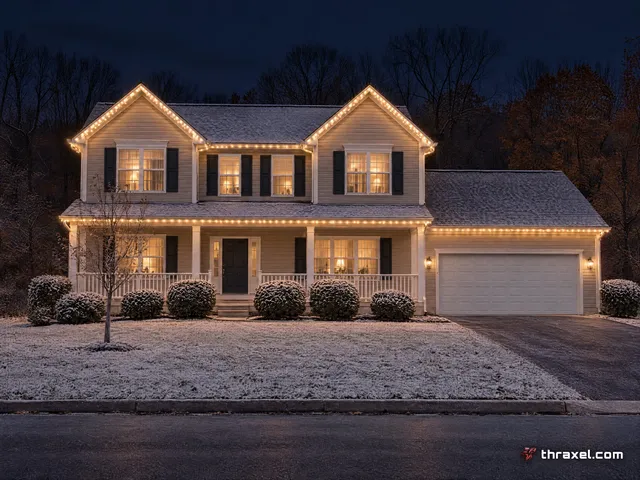
A seasonal C9 string is a series of small sails. Each bulb sits proud of the roof edge, each clip holds a few inches of wire, and the whole line is free to lift and swing between clips. A gust gets under one bulb, lifts a section, pops a clip, and now the next section has more slack to lift. It cascades along the eave.
That is why the first call after a windy night is always about a section hanging off a gable end or a corner. Corners and peaks see the highest wind speed on any house, and they are where a clipped string has the least support. Our seasonal crews fix those within 24 to 48 hours at no charge, but the point of a permanent system is not needing the call.
We wrote a fuller comparison of the two mounting methods at thraxel.com/blog/track-mounted-vs-clip-mounted-lights/ if you want the mechanics without the weather.
How the track is mounted
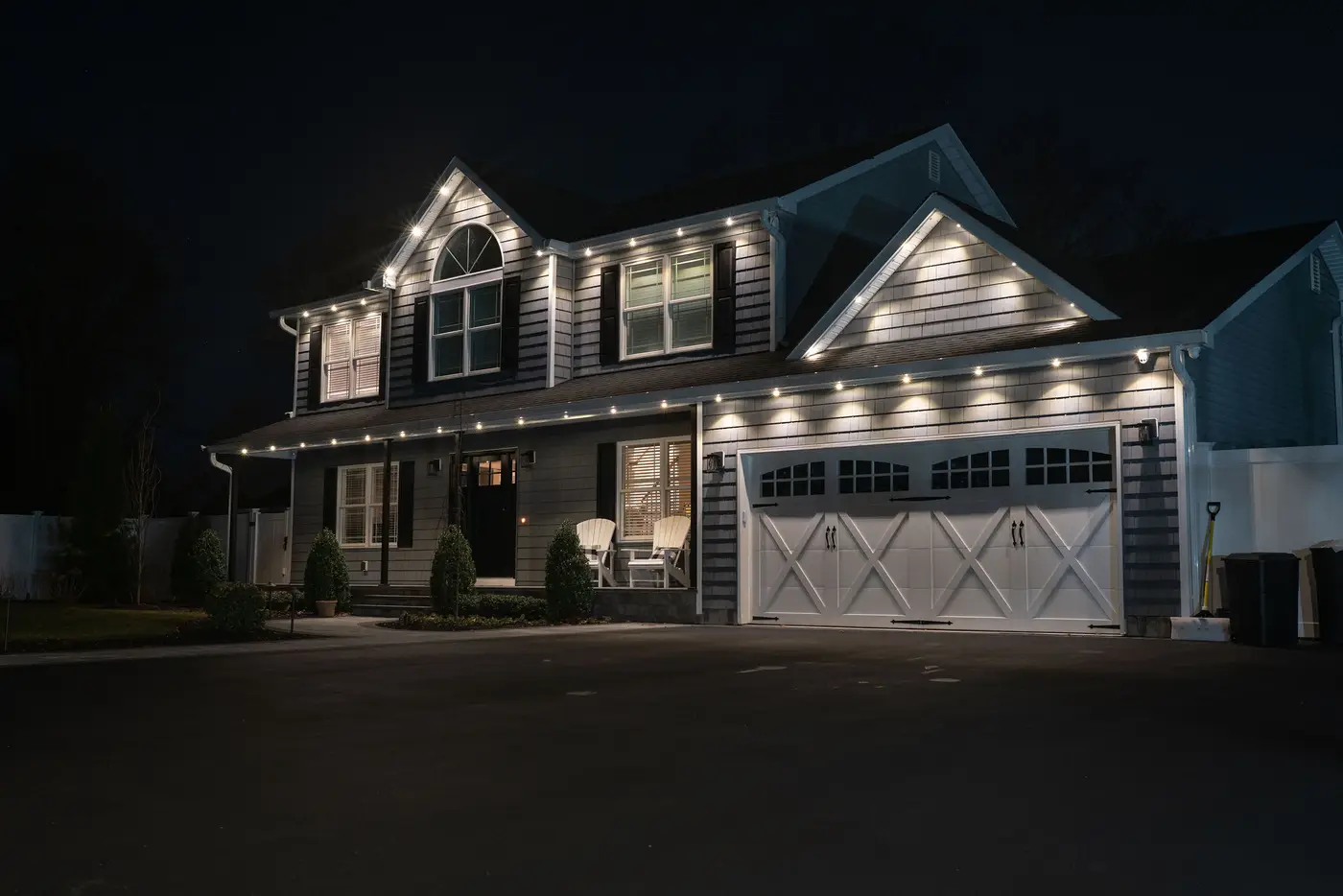
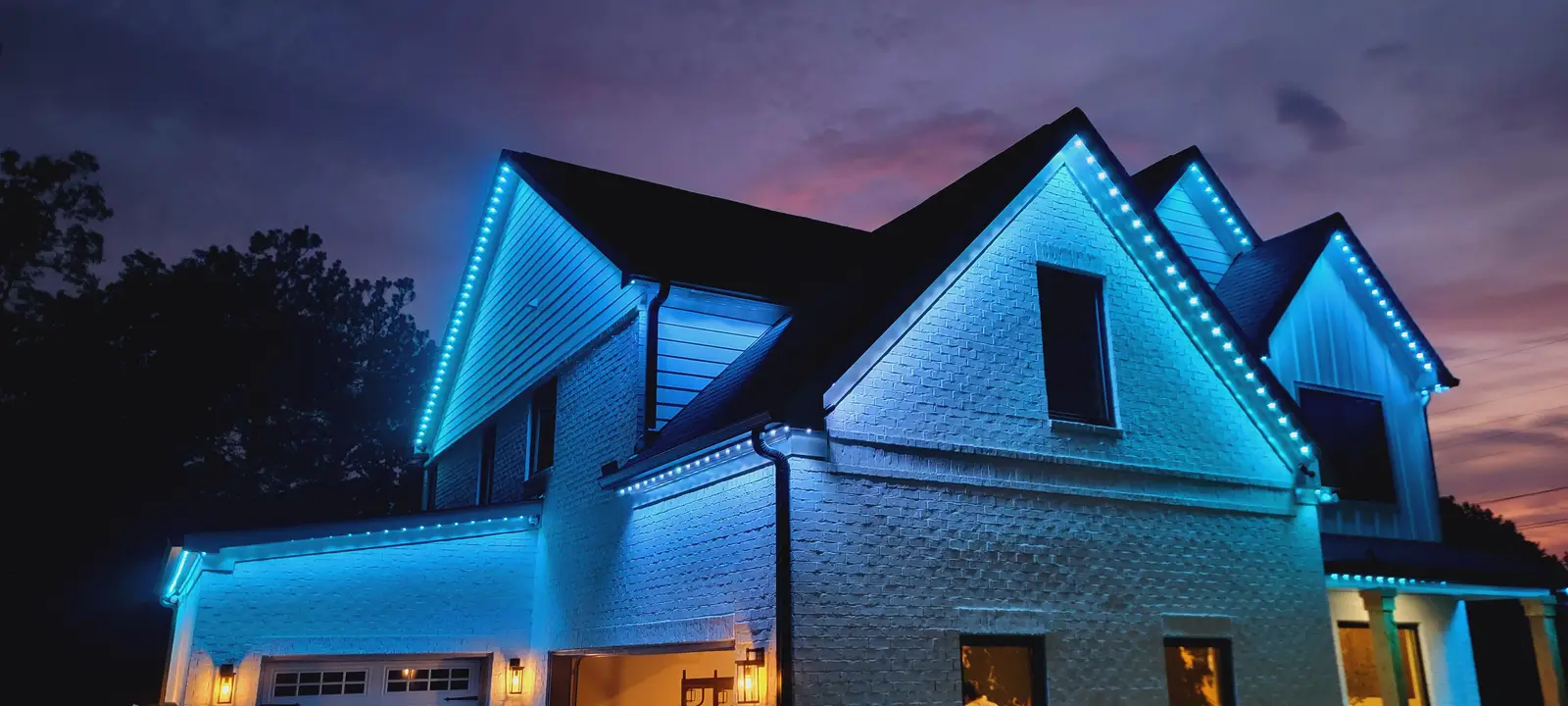
Permanent lighting from Thraxel runs inside an aluminum channel that is color-matched to the trim and fastened to the fascia along its entire length. There is no span of free wire between attachment points, because the track is the attachment point, end to end. Wind hitting the roof edge meets a smooth, closed profile with nothing to lift.
The pixels sit inside that channel, sealed in marine-grade silicone rated IP67, on 16-gauge wire. They do not stick out into the airflow. Even the diffuser face is flush, which is also why the whole run is effectively invisible from the street in daylight and why it has passed every HOA we have worked in.
Corners, peaks and gable ends get the same continuous mounting as the straight runs. Those are the spots where clip-hung lights fail, and they are the spots where the track design matters most. The spec sheet is at thraxel.com/permanent/.
- Continuous fastening along the fascia, not point clips
- Closed aluminum profile with no bulbs projecting into the wind
- Pixels and wire fully enclosed inside the channel
- Same mounting at peaks and corners where gusts are strongest
Rain, hail and the electrical side
The water that comes with a front is handled by the same IP67 seal that handles snow. Driving rain against a roof edge is nothing new to a pixel that can sit submerged. Hail is a physical strike, and the aluminum track takes it rather than the pixel. We have not seen hail crack a housing in the field, and if one ever does, it is a warranty part for 3 years.
Lightning is the real storm risk, and it is a controller risk rather than a lighting risk. A nearby strike or a utility surge can damage the controller or power supply the same way it can damage a router. We recommend surge protection on the circuit feeding the system, and we covered the options at thraxel.com/blog/surge-protection-for-exterior-lighting/.
After a storm, the app is your inspection tool. If every zone responds, the system is fine. If the controller is offline, check the breaker and the GFCI before assuming the worst. Nine times out of ten that is the whole repair.
Where wind can still do damage
Trees. A limb that comes down across a roof edge will hurt the track exactly as much as it hurts the gutter and the shingles under it. Nothing we mount is going to stop a falling oak branch, and we do not claim otherwise. Homes in wooded lots around Murrysville and Fox Chapel should think about tree health before the first big front, for reasons well beyond lighting.
Wind-driven debris is the smaller version: a neighbor's patio umbrella, a trampoline, a sheet of plywood from a job site. Again, a physical strike. The track will usually take a dent and keep working, and a section can be replaced without pulling the rest of the run.
A fascia board that is already rotten or loose is the one installation-side risk. We inspect the trim during the consult and note any soft spots on the render. Track mounted to bad wood is bad track, and we would rather tell you now than fix it in March.
What we check after a big storm
For our permanent customers, nothing is required from you. Open the app, run a scene, confirm every zone lights. If a zone stays dark or a single pixel is out, the controller reports which one, and Tyson can bring the replacement on the first visit. Reach Thraxel at 724-859-4390.
For seasonal customers, walk the yard and look at the peaks and corners. If a string is hanging, take a photo and send it. The repair is covered and scheduled inside 24 hours.
The honest summary: wind is what separates a lighting product from a lighting installation. The product is sealed and rated. The installation, continuous track on sound fascia, is what keeps the product where we put it. That is the part you are paying a crew for.