Real numbers, not averages
Why a national price calculator can not tell you what your house costs
Online lighting calculators work off national averages and a form you fill in yourself. A free Thraxel quote works off your actual roofline, measured in person, with a render of your house attached. One is a guess, the other is a plan.

What a calculator actually knows about your house
An online calculator knows whatever you typed into a few dropdown fields: house size, maybe roofline footage if you happen to know it offhand, maybe your zip code. It does not know your fascia condition, your roof pitch, where your electrical panel sits, or whether an HOA will affect your timeline.
It runs that limited input against a national average and spits out a range. The range is not wrong exactly, it is just not about your house specifically, and it never was designed to be.
Some calculators also assume a single, uniform house shape behind their math, which quietly skews results for anything with dormers, an attached garage, or a wraparound porch, all common features across Western PA housing stock.
What a free consultation actually knows
A Thraxel consultation starts with someone standing in your yard, measuring the actual roofline, noting fascia condition, checking for an existing outlet near the eaves, and asking what you actually want the lighting to do. That is fundamentally different information than a form.
The number that comes back within 24 hours, attached to a render of your specific house, reflects what your project would genuinely cost, not what a national average of unrelated houses suggests it might.
It also catches details a form could never surface, an existing outlet in the wrong spot, a fascia board that needs attention before track goes up, or an HOA rule specific to your neighborhood that changes the timeline.
Where national ranges are still useful
National industry estimates commonly fall between roughly $20 and $50 per linear foot installed for permanent lighting, roughly $2 to $6 per linear foot or $500 to $2,500 or more per season for professional seasonal Christmas lighting, and roughly $150 to $400 installed per landscape fixture. These ranges are honest and useful for a first sense of scale.
What they cannot do is account for a two-story colonial with dormers versus a single-story ranch with a simple roofline, or a house with an existing outlet near the eaves versus one that needs new electrical run. That gap is exactly what a real quote closes.
Treat a range from any calculator as a starting orientation for a first conversation with family or a spouse about whether to explore lighting at all, not as a number to hold a contractor to later.
- A calculator gives a national range, based on averages
- A Thraxel quote gives a specific number, based on your measurements
- Only one of them comes with a render of your actual house
The render is the part a calculator can never do
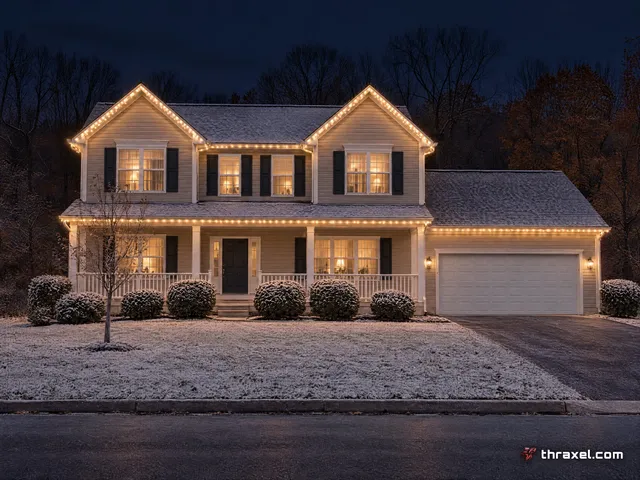
No online tool can show you what your specific roofline would look like lit, because that requires knowing the exact shape and layout of your house, not a category of houses. The design mock-up, covered fully at thraxel.com/blog/the-48-hour-render-mockup-explained/, is the piece that turns a number into a decision you can actually picture.
A calculator answers roughly what should this cost. A render answers what would this actually look like, and that second question is usually the one that matters more.
It also lets you weigh a warm-white-only look against a full RGBWW system with actual visuals in front of you, rather than trying to imagine the difference from a description in a calculator's results page.
It costs the same amount: nothing
The trade-off is not price, since both a calculator and a Thraxel consultation cost you nothing. The trade-off is accuracy and confidence. A form you fill out yourself takes two minutes and gives you a rough range. A free visit takes half an hour and gives you a real number, a render, and someone who can answer questions on the spot.
Given that neither costs money, there is not much reason to settle for the rougher of the two answers.
The only real cost of the in-person visit is time, roughly thirty to forty minutes, which most homeowners find is worth trading for a number and a picture they can actually plan around.
Getting the real version
If you already ran your address through a calculator somewhere and want to see how it compares to an actual measured quote, bring that number to the consultation. Tyson is happy to talk through where it lands relative to your real numbers.
Start at thraxel.com/quote/ or reach him directly at 724-859-4390 for the version that is actually about your house.
There is no downside to getting both. Run the calculator for a quick first impression if you want, then bring it into a free consultation and let the measured version settle the actual number.