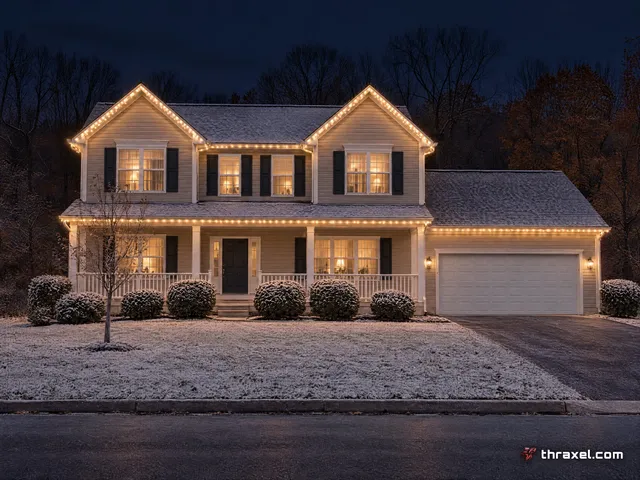
The render
Why we render your actual house before anyone cuts a piece of track
Within 24 hours of the consultation, you get an image of your own house lit up, not a stock photo with a generic roofline pasted on. Here is what that render is built from and why the process takes two days instead of two minutes.
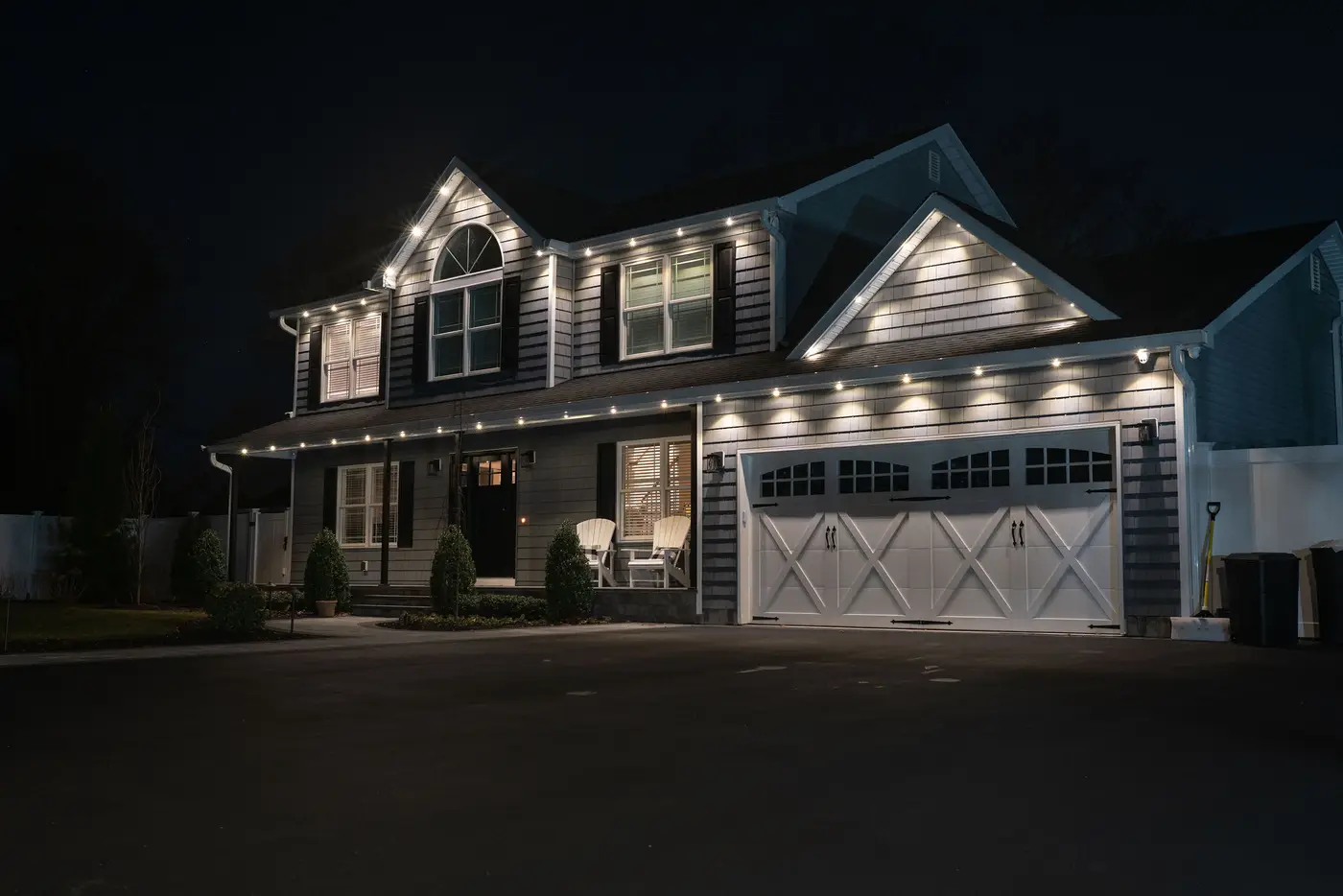
It starts with your measurements, not a template
A lot of lighting companies show you a sample photo of somebody else's colonial and call it a quote. Thraxel does the opposite. The render is built from the measurements and photos taken during your consultation: the length of your roofline, the number of dormers, where the columns sit, how the fascia trim runs.
That means the picture you get back is your house, lit the way it would actually look, not an approximation. If your home has an odd roof pitch, a covered porch, or a detached garage you want included, that gets reflected in the render before anyone commits to a design.
This is different from the sample galleries a lot of installers rely on. A gallery photo shows what the product can do somewhere. Your render shows what it would do specifically on your fascia, your dormers, your roofline, measured on site rather than approximated from a listing photo.
Two houses on the same street with similar square footage can still need different render inputs, since one might have a longer roofline, an added garage, or extra columns along a front porch that change the whole zone count. The measurement step is what catches those differences early.
What goes into the 24 hours
Two days sounds like a long turnaround in a world of instant mockup apps, but a real render involves matching zones to your actual fixture count, deciding where the color-matched aluminum track would route, and building the image so the scene shown is one your system could genuinely run, not a fantasy graphic.
It also gives Tyson time to double check anything unusual from the visit against the photos, so what you see is accurate the first time rather than something that needs three rounds of revision after you have already gotten attached to it.
For a busy week the render can take closer to the full 24 hours, and for a straightforward roofline it sometimes comes back faster. Either way, the timeline reflects real design work, not a queue behind other unrelated jobs.
What the render actually shows you
For permanent lighting, you typically see the house in an everyday warm-white scene plus one or two accent scenes, since the whole point of RGBWW pixels is that the same roofline can run 16 million colors or a true 2700K warm white on command.
For a seasonal Christmas quote, the render shows the proposed roofline design, the wrapped trees if you asked for them, and how a wreath or garland package would sit against the house, all before a single Elf shows up with a ladder.
Commercial renders work the same way but scaled to the property, a restaurant facade, a plaza entrance, or a hotel porte cochere shown in the scenes that fit the business, rather than a residential template applied to a building it was never built for.
- Zone-by-zone layout: eaves, soffits, columns, fascia, whatever you discussed
- At least one warm-white and one color scene for permanent quotes
- A firm number attached, since the render and the quote arrive together
Why the render matters more than the pitch
Most people cannot picture 168 pixels along a roofline from a verbal description. The render solves that problem honestly, and it also solves a trust problem. You are not buying based on a salesperson's confidence, you are buying based on a picture of your own house that either looks right to you or does not.
If it does not look right, that is useful information too. Adjustments happen before anything is installed, not after a crew has already tucked track against your fascia.
It also lets you compare quietly against other estimates you might be weighing. A vague verbal pitch is hard to hold up next to anything concrete. A render sitting in your inbox is easy to sit with, forward to a spouse, or set beside another company's proposal.
What happens after you see it
You take as long as you need. Some homeowners approve the render the same day it lands in their inbox, others sit with it through a full budgeting cycle, covered at thraxel.com/blog/reading-a-lighting-quote/. There is no expiration pressure built into the process.
When you are ready, a text to Thraxel at 724-859-4390 or a reply to the render email schedules install. Most homes go from approved render to finished install inside a week or two, depending on the season and the route.
If your plans change, a render does not lock you into a specific fixture count forever. Homeowners who decide to add a zone after living with the initial approved design just start a new short conversation rather than reworking the original render from scratch.
The honest limits of a render
A render is a strong approximation, not a photograph, because the actual RGBWW output looks slightly different depending on ambient light, camera and screen. That is one reason the driveway demo case exists alongside the render, so you see real hardware and not just a digital version of it.
If your consultation did not include the demo, ask for it. Seeing four live strips next to the render image is the combination that gets most people to a confident yes.
Screen brightness and settings also change how a render looks, viewing it on a dim phone at night reads differently than an office monitor at noon. None of that changes the underlying design, only how vivid the colors appear on your particular device.