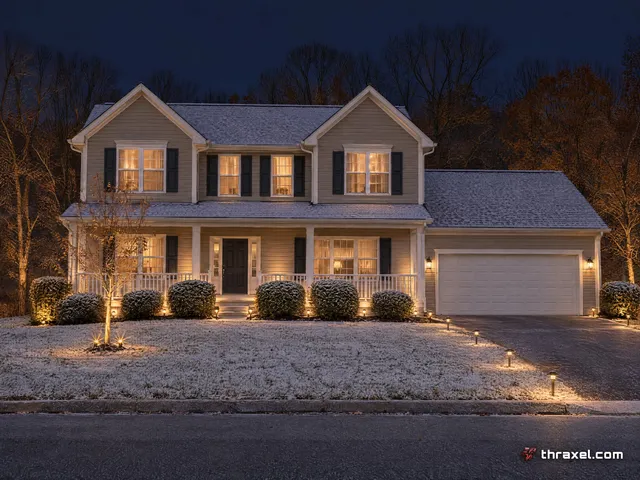
Trees after dark
How to uplight a tree so it actually looks right at night
A bad tree uplight looks like a spotlight stuck in the mulch. A good one makes the canopy look like it is glowing from the inside. The difference is fixture placement, angle and how many points of light hit the trunk.

Why so many DIY tree lights look wrong
The most common mistake is one fixture, dead center at the base of the trunk, aimed straight up. That produces a single hot column of light and a canopy that fades to black past 15 or 20 feet. It reads as a lit stake, not a lit tree.
The second mistake is brightness. A fixture bright enough to reach a 40-foot oak's upper branches is often blinding from ground level. The trick is more fixtures at lower output, not one fixture pushed as bright as it goes.
A third mistake is skipping the daylight walk entirely. Trunk lean, low branches that block a straight sightline, and root flare that a fixture would otherwise sit right on top of are all things you only catch by actually standing at the tree before dark, not by guessing from a photo.
Where fixtures actually go
For most mature trees, two or three fixtures spaced around the base do more than one fixture ever could. Offsetting them breaks the single hot column and lets light wrap around branch structure instead of just the front face of the trunk.
Distance from the trunk matters as much as fixture count. A fixture set too close washes out the bark and blows out low branches. Pulled back a few feet, the same fixture skims up through the canopy and lets shadow and light trade off naturally.
Fixture height off the ground also plays a role. A well is sometimes sunk slightly below grade so the fixture itself disappears into the bed by day, leaving only the canopy lit at night rather than a visible metal can sitting in the mulch.
- Small ornamental trees: one to two fixtures, closer spacing
- Mature shade trees: two to three fixtures, spaced around the base
- Trees near a walkway: aim away from foot traffic to avoid glare
- Evergreens: lower output, since dense needles bounce light back down
Warm white or color for trees
Warm white is the right call for most trees, most of the year. It reads as moonlight, works with any exterior color, and does not fight with brick, stone or siding. It is also the choice that reads best in twilight listing photos if a home is heading to market.
Color-changing fixtures earn their keep on a signature tree, the one visible from the road or the one that anchors a party space. A single feature tree in RGB next to warm-white neighbors reads as intentional design, not a mismatch. See thraxel.com/blog/warm-white-vs-color-landscape-lighting/ for how we make that call zone by zone.
A common middle ground is warm white on the property's trees generally, with one specimen, often the largest or the one closest to the front door, wired for color so it can carry a Halloween or holiday scene without redesigning the whole yard.
Winter changes the picture
A tree looks different in every season, and Western PA trees go through more visible change than most. Bare branches in January scatter light differently than a full canopy in July, and snow load can shift a fixture that was aimed perfectly in October.
Astronomical timers keep the on and off schedule correct as daylight hours shrink and grow, so nobody is out resetting a clock in November. thraxel.com/blog/what-are-astronomical-timers/ covers how that piece works.
A tree that looks understated in summer, once full leaf cover softens and diffuses the light, can look dramatically brighter in winter once branches are bare and there is nothing left to scatter the beam. That seasonal swing is part of what a design accounts for up front.
What a consult looks at
On a walkthrough we look at trunk diameter, canopy height, branch density and how close a trunk sits to a walkway, patio or window. A dense evergreen 10 feet from a home needs a different plan than a mature oak standing alone in the yard.
National industry estimates commonly run roughly $150 to $400 installed per fixture, and a single tree can need one fixture or three depending on size. A free on-site walkthrough gets you an exact count instead of a rough guess.
Root systems also factor in. A well-established tree with surface roots near the trunk limits exactly where a fixture can be set, and an installer who has actually walked the tree will know that before a single hole gets dug.
Trees near the house versus trees standing alone
A tree close to a home's facade often gets lit as part of the same design pass as the facade itself, so the two do not compete or create odd double shadows on the siding or stone behind the canopy. Spacing and brightness get adjusted specifically for that relationship.
A standalone specimen tree out in the lawn, with nothing behind it, can carry more dramatic lighting since there is no adjacent wall or window to worry about washing out. These are often the trees homeowners choose for a color-capable fixture, since they read as their own visual moment from the street.
Trees along a property line or near a neighbor's yard need a different consideration entirely: aim and brightness that stay on your property and do not spill glare across a fence line, which is part of what gets discussed on a walkthrough before anything is installed.
A young tree still growing into its mature canopy is worth flagging on the walkthrough too, since fixture placement chosen for a five-year-old sapling will likely need revisiting once that same tree has doubled in height and spread a decade later.