Restaurants
Restaurant exterior lighting that fills tables after dark
Drivers decide whether a restaurant is open in about two seconds, and they decide it from the road. Exterior lighting that says open, warm and current is the cheapest table-filler most owners in Western PA have never bought.

The problem with a dark building
Most restaurants in the Pittsburgh region sit on a state route, a strip plaza or a small-town main street, and most of them go dark at 5 p.m. from November through March. A lit sign on a black building looks like a place that forgot to lock up. The customer keeps driving to the one that looks alive.
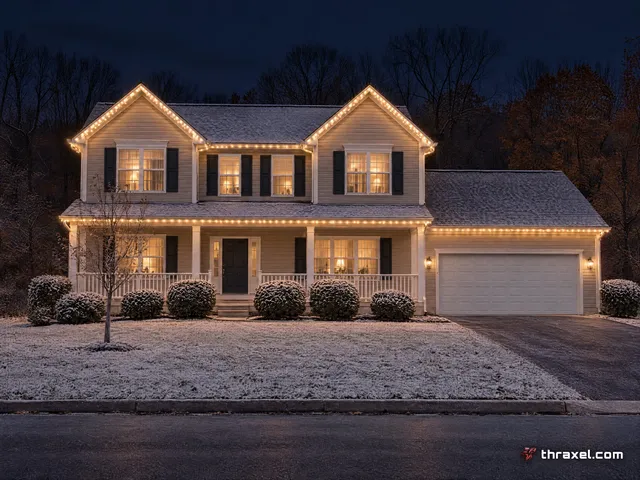
Interior light through the windows does not fix this. It reads as a glow from inside a box. What changes the read from the road is the outline of the building itself: the roofline, the entry, the patio edge and the sign. Light those and the whole property says come in.
We put permanent lighting on quick-service restaurants, sit-down places, breweries and event venues across the region. The system detail lives at thraxel.com/permanent/, and this post is about how to use it on a restaurant specifically.
Four zones that matter on a restaurant
Roofline first. A warm-white roofline is the single largest visual change you can make, and it works on a flat-roof QSR box as well as a gabled farmhouse restaurant. The track is color-matched and sits tight to the fascia, so by day the building looks exactly like it did before.
The patio zone earns its keep in the shoulder seasons. A pergola or fence line washed in warm white with a firepit going extends outdoor seating into October and brings it back by April. More on the patio side at thraxel.com/blog/firepit-and-patio-lighting/.
- Roofline and parapet: the outline drivers see from 300 feet out
- Entry and canopy: where people decide it is safe to walk in
- Patio, pergola and fence line: turns a March patio into a usable one
- Signage and facade accents: a lit sign on a lit building instead of a lit sign on a dark one
Scenes that sell food
Everyday Warm is the baseline: a true 2700K warm white from a dedicated diode, not a blend that reads pink on a stucco wall. Set it to come on at dusk and off at close and forget it exists.
Then layer the calendar. Red and green from Thanksgiving to New Year. Orange and purple for the last two weeks of October. Red, white and blue for the Fourth. Black and gold on any Sunday the Steelers play, and green for St. Patrick's Day if you pour beer. Every one of those is a scene in the Thraxel Lighting app and takes one tap or one schedule entry.
For a grand opening, a fish fry Friday in Lent, or a live music night on the patio, a manager can run a color pulse or a music-synced scene from a phone. Nothing goes up, nothing comes down.
What it replaces
Ask what the building spent last year on holiday decor, the lift or ladder time to hang it, the repair call when a string died in mid-December, and the labor to pull it in January. Then ask what it cost to look closed for ten months. A permanent system replaces the first list and fixes the second.
It also removes the ladder from the property. No employee on a roof in a Butler County sleet storm. The crew doing the one-time install is fully insured, wears proper PPE and only works when weather permits.
Energy is small. At roughly 0.3 watts per pixel, a long restaurant roofline is still cheaper to run nightly than the propane heaters on the patio.
Seasonal is still an option
Some owners want real glass C9 bulbs for the holidays and nothing else. That is a legitimate choice and we hang C9 rooflines on quick-service and family restaurants every November, with in-season repair covered and takedown beginning January 4. The full breakdown for that path is at thraxel.com/blog/quick-service-restaurant-christmas-lights/.
If the building is up for a re-roof, a re-brand or a sale inside two years, seasonal lights are the right call for now and permanent comes later. We will say so on the walk.
How a restaurant quote works
It starts on site, free, usually between lunch and dinner service so we are not in the way. We measure every run, find the panel, and set the demo case on the sidewalk so the owner can scroll colors against the real facade. A render of the building comes back within 24 hours.
Most restaurant installs are one to two days and we schedule around your service windows. Tyson quotes and runs every job at 724-859-4390, and the form at thraxel.com/quote/ has a commercial property type. Plazas around Monroeville, Butler and the North Hills are on the regular route.