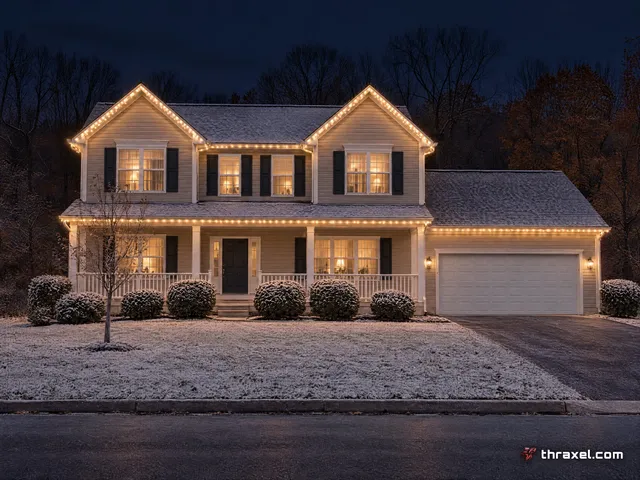
Service vs system
You never actually own seasonal Christmas lights. Here is what that means.
With the seasonal program, Thraxel owns, stores and reinstalls the same lights on your house every winter. With a permanent system, the lighting belongs to you the day it goes on the eaves. Both are valid, and the right one depends on what you want the other eleven months.

What you are actually paying for with seasonal service
When you book the seasonal program, the lights themselves are not really yours in the way a purchase would be. Thraxel designs, installs, maintains and stores the same components year over year, and you pay for the service of putting them on your house and taking them back off.
That arrangement has real upside. You never store a tangled bin of C9 bulbs in your garage, you never inventory what broke last year, and you never climb a ladder in January to bring anything down. The service absorbs all of that.
It also means the display can change from year to year without you owning the change. A different color scheme or an added tree wrap is simply part of the following year's design conversation, not a purchase of new equipment on top of what you already have sitting in storage.
Think of it less like a lease with a fixed term and more like a subscription you can pause. Skipping a season, or scaling the display up or down, is a conversation at the next consultation rather than an asset you have to sell off or store yourself.
It also removes any question of what to do with the lights if you move. There is nothing to pack, sell or leave behind for the next owner, since the service was never tied to owning the physical materials in the first place.
That same question looks different with a permanent system, since it is mounted to the house rather than to you. It generally stays with the property when it sells, which is worth factoring in if a move is on the horizon.
What ownership looks like with a permanent system
A permanent RGBWW system is a different kind of transaction. Color-matched track goes under your fascia once, and from that point forward the lighting is a fixture of the house, the same as a gutter or a light fixture over the front door.
You own it outright, backed by a 3-year parts and 1-year labor warranty, and 0% APR financing up to 24 months is available for qualifying buyers. There is no annual invoice for a Christmas display. The electricity is roughly $52.80 a year for a typical 168-LED install run six hours a night.
The tradeoff for ownership is that a permanent system is not exclusively a Christmas product. It runs red and green scenes for the holidays, but it is capable of far more than that the rest of the year.
Ownership also means the system is yours regardless of who services it going forward. It is mounted to your fascia, controlled from your own app account, and not tied to renewing a seasonal booking every fall the way rented service is.
It also comes with a maintenance profile most homeowners do not expect. Individually addressable pixels mean a single failed one is diagnosed on its own, with replacements typically handled same day, rather than an entire run needing attention.
How the cost shape differs
We do not print Thraxel prices in a blog post, since every roofline is priced individually and the quote is free. But the general shape holds across homes. Seasonal service is a smaller number that repeats every November. A permanent system is a single larger number that does not repeat.
National industry estimates commonly put a professional seasonal install between roughly $2 and $6 per linear foot, or roughly $500 to $2,500 or more for a typical home per season. Permanent systems commonly fall between roughly $20 and $50 per linear foot installed. Every house measures out differently, so the walk-through is what turns those ranges into a real number.
Run those ranges out a few winters and a permanent system typically catches up to the cumulative cost of renting the seasonal service. Exactly when depends on roofline length and how elaborate the seasonal design is each year.
0% APR financing for up to 24 months is available for qualifying buyers on a permanent system, which can make the upfront number closer to what a couple of seasons of rented service would have cost, spread across the same window.
Who each option actually fits
If you want a classic warm-white or multicolor look for one month a year and nothing more, paying for the seasonal service every winter is a perfectly reasonable choice, especially if you are not sure you will be in the house long term.
If you are done thinking about it every November, or you want a house that also runs a Halloween scene, a July 4th scheme and a black-and-gold display on Sundays, owning the system outright starts to make more sense than renting the same look every year.
- Seasonal service fits: short-term homeowners, classic C9 fans, one holiday a year
- Permanent ownership fits: multi-holiday households, HOA neighborhoods, anyone finished with January ladders
How to figure out which one is you
Both options start the same way, with a free on-site consultation. See thraxel.com/blog/permanent-vs-seasonal-christmas-lights/ for a deeper side-by-side once you have narrowed it down.
Text or call Thraxel at 724-859-4390 and describe how you use your house today. Tyson will tell you honestly which one fits, not just quote whichever is more expensive. Details on the permanent system are at thraxel.com/permanent/.
There is no wrong first step. Plenty of homeowners in Indiana and Kittanning start with a season or two of the rented service simply to see how the design looks on their house before deciding whether to commit to owning it outright.