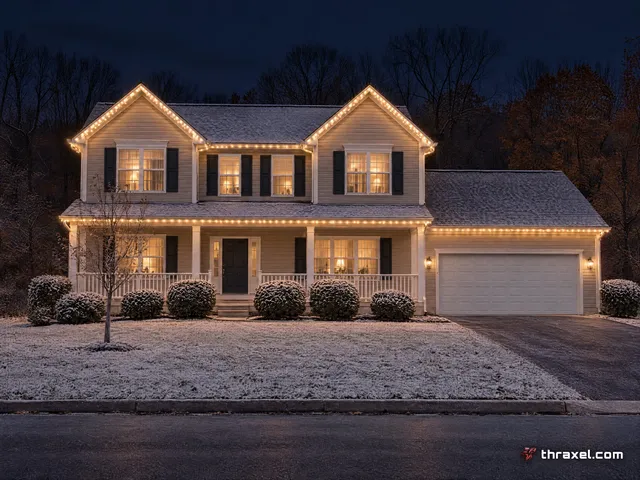
HOA suburbs
Getting exterior lighting past an HOA board
Cranberry Township, Wexford, Gibsonia, Peters Township, and most of the newer Pittsburgh suburbs run on HOA rules, and lighting is one of the more common items a board reviews. Here is how permanent lighting fits inside those rules.

Why HOAs get involved in lighting at all
Most HOA design guidelines exist to keep a street looking consistent, which usually means rules about what can be visible on the exterior of a house and for how long. Seasonal string lights run into that directly, since they are a temporary visible fixture with a removal deadline attached in a lot of communities.
Permanent lighting sidesteps the entire category of concern. The color-matched aluminum track mounts flush against the fascia and is effectively invisible by day, so there is nothing on the roofline for a board to object to during daylight hours.
Many guidelines also restrict how long a holiday display can stay up, since a board rarely wants string lights hanging into February. Because a permanent system is not a physical decoration at all, that particular clause simply does not apply, which removes one of the more common friction points between homeowners and a board every winter.
The track record across these communities
The system has passed every HOA Thraxel has worked in, across the Route 19 corridor, Peters Township, and the rest of the suburban ring around Pittsburgh. That is not a guarantee about a specific community's future decisions, but it reflects a real pattern across the communities the crew has already worked in.
Boards generally respond well to seeing the finished look before deciding, which is where the free design mock-up earns its keep. It shows the exact house, at night, with the system running, rather than a generic marketing image.
Thraxel is fully insured, and every component going onto the roofline is UL, ETL and CUL certified, which tends to answer a board's liability questions before they are even asked. Crews also hold the manufacturer-required certifications for the install itself, not just the equipment.
- No visible fixture by day, nothing to schedule a removal deadline around
- Design mock-up gives a board a real visual instead of a written description
- Scene changes happen from the app, no physical decoration to install or remove
Bringing it to a design-review board
If your community requires architectural review before exterior changes, the design mock-up is the single most useful document to bring. It shows the color-matched track against your actual roofline and the lit result, which answers most of the questions a board tends to ask up front.
We are happy to provide additional detail on the components, including their IP67 marine-grade rating and UL, ETL and CUL certifications, if a board wants written documentation alongside the visual.
If your community uses a management company rather than a volunteer board, loop them in on the timeline early. Architectural review meetings on a monthly or quarterly calendar are common in HOA-governed suburbs, so lining up the design mock-up with the next scheduled meeting avoids a longer wait for the following one.
What happens for holidays and special colors
A common HOA concern is whether holiday displays will be excessive or long-running. Because scenes are controlled from the app, a Halloween or Christmas look can be scheduled to start and end on specific dates automatically, which avoids the classic problem of decorations left up two months too long.
Named scenes on the system include Everyday Warm, Game Day, Christmas, July 4th and Halloween, along with Valentine's Day and St. Patrick's Day, all switched without anything physically going up or coming down on the house.
For households weighing the upfront number against a board's tolerance for a large project, 0% APR financing for up to 24 months is available to qualifying buyers, which spreads the install cost without changing anything about how the system reads to a design-review committee.
Neighborhoods where this comes up most
Cranberry Township, Wexford and Gibsonia are the communities where lighting reviews come up most often on our consults, largely because of how many newer HOA developments sit in that stretch of the county. Peters Township, further south, is another area where board approval is a routine step rather than the exception.
Older, established Pittsburgh suburbs without an HOA structure skip this step almost entirely, which is worth mentioning since not every property in the region needs board sign-off before an install. Knowing which category your street falls into ahead of the consultation saves a step in the process either way.
See the Cranberry Township-specific breakdown at thraxel.com/blog/cranberry-township-permanent-lighting/ if that is your community.
HOA neighborhoods also tend to care about resale consistency across the street. In Thraxel's 2023 to 2025 residential tracking, homes with permanent lighting appraised 3 to 7 percent higher on average, a directional figure rather than a guarantee, which is worth weighing alongside the board approval question for anyone thinking about resale down the road.
Starting the approval process early
If your HOA requires a formal application, start the consultation early enough to have the design mock-up in hand before your board's next meeting. A free on-site visit is the first step, and thraxel.com/quote/ is the fastest way to get one on the calendar.
Most Pittsburgh suburb installs are finished in one to two days once a board signs off, and the final walkthrough covers scene setup so a homeowner leaves install day already knowing how to switch between Everyday Warm, Game Day and the seasonal scenes without opening a manual.
If you have a quick question before committing to a full consultation, Randy, the AI assistant on the thraxel.com site, can answer general questions about the process any time, though the actual walk of your property still happens in person with the crew.
Warranty coverage runs 3 years on parts and 1 year on labor regardless of which HOA-governed suburb the address falls in, and the crew that measures the roofline is the same crew that comes back to hang the track, not a subcontractor pulled in for the job.