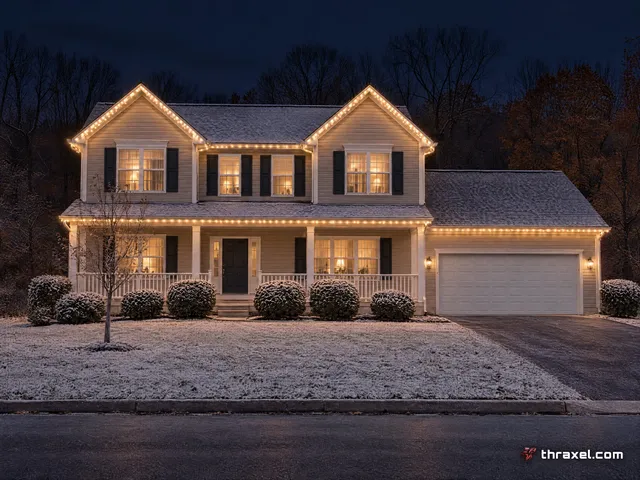
Under the hood
How permanent roofline lighting works, from your thumb to the fascia
You tap a scene on your phone. A controller on the house reads it, pushes a data signal down the line, and every pixel in the track sets its own color. That is the entire system. Here is each link in the chain and why it is built the way it is.

The chain in four links
Permanent roofline lighting has four moving parts, and only one of them is on your phone. The app sends a command. The controller receives it and converts it into a data stream. The wire carries that stream along the roofline. The pixels read it and light up. Everything else, the track, the silicone, the certifications, exists to keep those four links working through a Pennsylvania winter.
We get asked to explain this on almost every consult in Armstrong and Butler County, usually by the person in the house who wants to know what they are actually paying for. Fair question. The product page at thraxel.com/permanent/ lists the specs. This is the plain-language version of how they connect.
Link one: the app
The Thraxel Lighting app is where you live day to day. It holds the scenes we set up on install day, Everyday Warm, Game Day, Christmas, July 4th, Halloween, Valentine's Day and St. Patrick's Day, and any scene you build after that. You pick colors, set schedules, choose a warm-white level, or turn on music sync.
The app talks to the controller over your home network. It also hands off to Alexa, Google Home, Apple HomeKit and Control4, so a voice command or a whole-home automation can trigger the roofline the same way a tap does. For campers and RVs we install a Bluetooth version that needs no Wi-Fi at all.
Link two: the controller
The controller is the translator. It takes the scene the app sends and turns it into a stream of instructions, one instruction per pixel, in the order the pixels sit along the track. It also handles the schedule when your phone is nowhere near the house, so the roofline still comes on at dusk while you are at a Friday night game in Butler.
We size and place the controller during the consult based on the runs on your property. Its job is simple and it does it constantly: listen for the app, keep the schedule, feed the line. We wrote a full post on it at thraxel.com/blog/permanent-lighting-controller-explained/.
Link three: the wire and the track
From the controller, 16-gauge wire runs the length of the install. Sixteen-gauge is heavier than the wire in a typical consumer string light, and that matters for two reasons. Thicker copper carries power farther without the far end dimming, and it survives the flexing, freezing and UV exposure that thin wire does not.
The wire and pixels sit inside a color-matched aluminum track that mounts tight against the fascia. The track is what makes the system disappear in daylight, and it is also what protects the pixels from ice sliding off the roof. Nothing hangs, nothing clips, nothing staples.
Link four: the pixels
Each pixel is an RGBWW LED module: red, green, blue and a dedicated 2700K warm-white diode, sealed in IP67 marine-grade silicone. Each one has its own address on the line. When the data stream comes down the wire, pixel 40 reads instruction 40, ignores the rest, and lights the color it was told.
That individual addressing is what turns a strip of lights into a display. A chase pattern is just the controller changing which address gets which color each fraction of a second. Alternating red and green is every odd address one color and every even address another. Warm white is the fourth diode alone, with the color diodes off.
- RGBWW: 16 million colors plus a real warm white, not a mixed one
- Individually addressable: any pixel, any color, any moment
- Roughly 0.3 W per pixel, about $52.80 a year for a typical 168-LED roofline at six hours a night
What happens when a link fails
Because each pixel has an address, a failure is not a mystery. The controller and the app can identify exactly which pixel stopped responding. We come out, swap that pixel, and the line is whole again, typically the same day. Compare that to a string light where one dead bulb means testing the whole strand by hand in the cold.
The system is covered by a 3-year warranty on parts and 1 year on labor. Components are UL, ETL and CUL certified, and the crew holds the install certifications the manufacturer requires.
Why the chain matters when you compare quotes
Any permanent lighting quote you get should be able to answer four questions: what app controls it, what the controller does when your phone is away, what gauge the wire is, and whether the pixels are RGBWW or RGB only. If the answer to any of those is a shrug, keep shopping.
We would rather show you than tell you. The consult is free, we bring a live demo case to the driveway, and the render of your actual house comes back within 24 hours. Book it at thraxel.com/quote/ or call Thraxel at 724-859-4390.