No ladders
The safest Christmas light install is the one you never climb for
A gutter, a wet rung, a homeowner who insists on doing it themselves every year. It is one of the more common ways a holiday season goes sideways. A professional crew removes the ladder from the equation entirely, for good.

Why this comes up so often in November calls
It is a common conversation. An adult child calls about their parents' house, worried that Dad is still going to insist on the ladder this year the way he has for thirty winters, cold hands and all.
Sometimes it is the homeowner calling directly, having decided on their own that this is the year they stop climbing. Either way, the reason behind the call matters less than getting the ladder out of the picture.
Balance, grip strength and reaction time all change with age in ways that make a task that used to be routine genuinely riskier than it once was, even for someone who has never had a fall. Recognizing that ahead of time is what most of these calls come down to.
Winter conditions add another layer on top of that. A ladder set up on a frosty driveway or a wet lawn is a different proposition than the same ladder in July, and that combination is exactly when holiday decorating happens every year.
None of this is about taking away independence. It is about routing one specific, genuinely risky task, working at height in cold weather, to a crew trained for it, while everything else about how the household runs stays exactly the same.
It also tends to be an easier conversation than expected. Most homeowners who have been climbing that ladder for decades are relieved to have a reason to stop, rather than defensive about being asked.
Framing it around the tradition rather than the limitation tends to land better too. The point is keeping the house lit the way it always has been, not taking anything away from how the season is celebrated.
What a full-service install actually removes
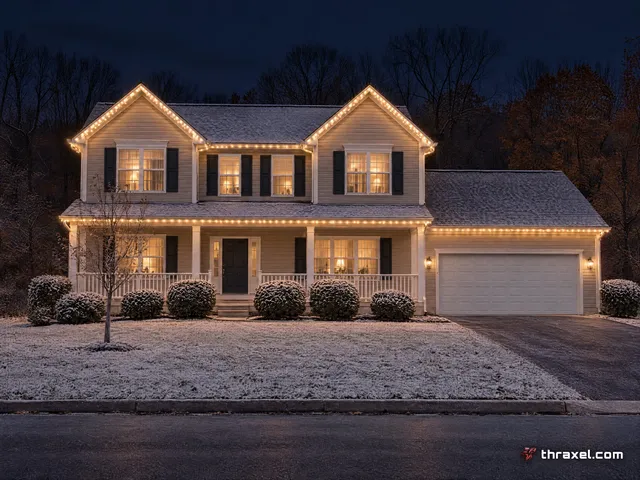
The obvious piece is the roofline itself. A trained crew, working in proper PPE, handles every section of ladder work, including the porch, the columns and any trees included in the design.
The less obvious piece is everything around the ladder work. No standing on a chair to reach an outlet, no walking an icy driveway carrying a tangled box of lights, no January trip up into the attic to put everything away.
It also removes the pressure to keep up with a display someone has done every year for decades. A crew handling the same layout, or an updated one discussed at the consultation, means the tradition continues without the physical part falling on the homeowner.
For a household where mobility is a bigger concern indoors as well as out, this often comes up alongside other changes being made around the house. Lighting is one of the easier pieces to hand off entirely, since it does not require anyone to be present for the physical work at all.
The permanent option: no ladder, ever again
Seasonal service removes the ladder for one install and one takedown a year. A permanent RGBWW system removes it permanently, since the track is mounted once and the display is controlled from an app afterward.
For a household that has decided the ladder conversation should not happen again next November either, permanent lighting is worth a look. Full detail on the system is at thraxel.com/permanent/, and the honest tradeoffs are covered at thraxel.com/blog/is-permanent-lighting-worth-it/.
It is not the right fit for every situation, and that is worth saying plainly. A homeowner who only wants classic warm white for one month and is comfortable with the seasonal program has no real need to switch. Permanent lighting solves the ladder problem either way, but it is a bigger decision than a seasonal booking.
Control matters here too. The Thraxel Lighting app works with voice assistants like Alexa and Google Home, which can make day-to-day operation of a permanent system easier for someone who finds a phone screen harder to manage than a simple voice command.
What families booking on someone's behalf should know
You can start the process for a parent or relative even if they are not the one calling. The free consultation happens at the property, and the design mock-up gets reviewed together before anything is installed.
Financing at 0% APR for up to 24 months is available for qualifying buyers if a permanent system is the direction the family chooses, which can make it easier to gift or split the cost among siblings.
It is also fine to start with a single season of the seasonal program as a lower-commitment first step, especially if the goal is simply to see how a parent or relative responds to no longer handling the ladder themselves.
What happens the rest of the season
If a bulb goes out or a wire comes loose over the following weeks, that is an in-season repair, not another trip up a ladder for anyone in the family. A call to Thraxel at 724-859-4390 gets it handled within 24 to 48 hours.
Takedown works the same way. Nobody in the house needs to touch the display again until it goes back up the following November, or ever again if the system installed is permanent.
For a family in Allison Park or Fox Chapel checking in on a relative's house from a distance, that consistency matters. The same crew, the same process, and the same no-ladder standard apply every single season.
It is a small thing to build into an existing check-in routine, whether that is a weekly phone call or a visit every few weeks. Asking whether the display looks right is a far easier ask than asking whether anyone has been up on a ladder lately.