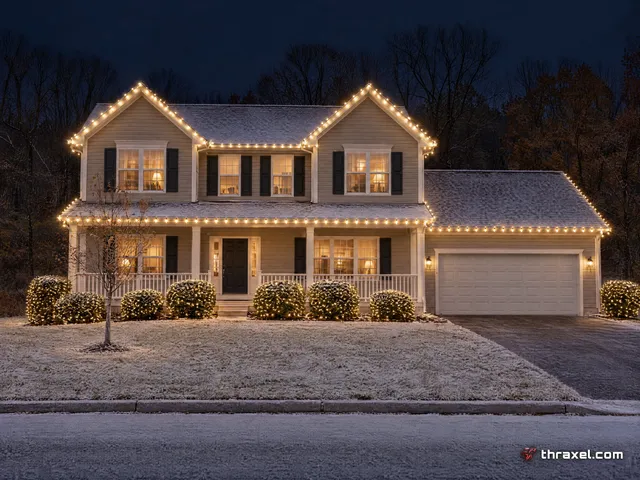
When timing matters most
A dark roofline the week before Christmas is not a January problem
Every failure gets fixed, but a dead section two days before a party feels different than the same problem in early November. Here is what actually happens when a light fails during the busiest weeks of the season.

Why December failures feel higher stakes
A house that has been dark on one side since Halloween is easy to shrug off. A house that goes dark two days before a family gets together, or the week a real estate agent is bringing buyers through for a twilight showing, is a different situation entirely.
The mechanics of the repair are the same either way, but the timeline matters more in December, which is exactly when the install calendar is at its busiest and hardest to work a same-week fix into.
It is also the month most homeowners are actually looking at their own house after dark, since guests are coming and going and the display gets used, rather than just glanced at on the way to the car.
A twilight showing tied to a home sale is one of the more specific December scenarios worth mentioning to whoever handles the repair call, since it can shift how quickly a visit gets prioritized on an already tight schedule.
A large gathering, a work party or a specific family tradition tied to a certain evening all count just as much as a real estate showing. There is no scenario too small to mention if the timing genuinely matters to you.
The goal is simply matching the response to what actually matters for your household that week, rather than treating every report exactly the same regardless of what is riding on it.
What actually causes most December failures
Cold snaps and ice storms are the biggest driver. A sudden freeze can loosen a connection that was fine in November, and heavy ice can pull a line away from a gutter or fascia board it was clipped to.
Wildlife getting into a wire is another common cause, especially where a run passes near a tree trunk. A single chewed section can take out an entire run if it sits upstream of the rest of the string.
Wind is the third factor. A gust strong enough to knock a section loose from its clips does not need to be a full storm, and it is one of the more common calls Thraxel fields in the weeks around the holiday itself.
A blown fuse or tripped outlet is a fourth, less dramatic cause. Cold weather can affect how an outdoor outlet behaves, and a section that seems dead sometimes turns out to be a simple power issue rather than a damaged string.
None of these causes are unique to December specifically. They simply happen more often as the season goes on, since components have been outside longer and winter weather tends to intensify as the month progresses.
What the repair process actually looks like
A call or text to Thraxel at 724-859-4390 starts the process, and a photo of the affected section speeds up the diagnosis before anyone drives out. That is the entire time commitment required on your end.
Under the seasonal program, that repair is scheduled inside 24 to 48 hours and there is no invoice for it, regardless of whether the cause was a burned-out bulb, ice, wind or wildlife. December calls get treated with the same urgency as any other point in the season.
If the timing lines up with a specific date, mentioning that when you report the issue helps the crew prioritize accordingly, though every report is already treated as time sensitive during the busiest weeks of the season.
The difference a service plan makes in December
A homeowner who strung their own lights is on their own for a December repair. That means their own ladder, their own cold hands, and their own trip to find a replacement bulb or connector, often while trying not to miss whatever the failure interrupted.
A homeowner under the seasonal program makes one call and the rest is handled. That difference is most obvious in exactly the week it matters, not in October when everything is still working fine.
It is worth saying plainly that a service plan does not prevent every possible failure. Weather and wildlife happen regardless of who installed the lights. What changes is how fast and how easily the problem gets solved once it does.
There is also a difference in what a DIY homeowner has to source on short notice. A specific bulb type or connector that matched what was originally installed is not always sitting on a shelf at the hardware store in the middle of December.
How to lower the odds before December starts
Most December failures trace back to connections or clips that were already under stress from wind or ice earlier in the season. Reporting anything unusual in November, even something minor, helps catch a small issue before it becomes a bigger one during the busiest weeks.
For a full breakdown of what in-season coverage includes year-round, see thraxel.com/blog/christmas-lighting-in-season-maintenance/. To start the season with a design built to hold up through Western PA winters, see thraxel.com/christmas/.
Around Monroeville and Murrysville, where roofline styles and tree cover vary a lot from block to block, the consultation is where a crew flags anything on your specific property likely to be exposed to wind or wildlife, so the design itself starts a step ahead of the problem.
None of this guarantees a failure-free December. It simply narrows the odds and, more importantly, means the plan for what happens if something does go wrong was already in place well before the first cold snap arrived.