Pool and deck
Pool deck lighting ideas built to survive the water, not just look good near it
A pool deck is the harshest zone on most properties: splash, chlorine, humidity and summer sun all in one spot. The fixtures that survive it are rated for it from the start, not retrofitted after the first one fails.
Why pool decks are hard on lighting
Between splash-out, pool chemicals, standing humidity and summer heat, a pool deck runs a lighting system through more stress than almost any other zone on a property. A fixture rated for a dry garden bed will not hold up here.
That is why every fixture Thraxel puts near a pool is IP67 marine-grade, sealed in silicone housing and salt-tested, the same standard used on dock installs. It is built for wet, not just splashed occasionally.
Chlorine specifically is harder on metal components than plain water, which is part of why the housing rating matters more here than on a fixture set well back in a dry bed. A poolside fixture is essentially living in a low-grade chemical environment every day it is in use.
Where the light actually needs to go
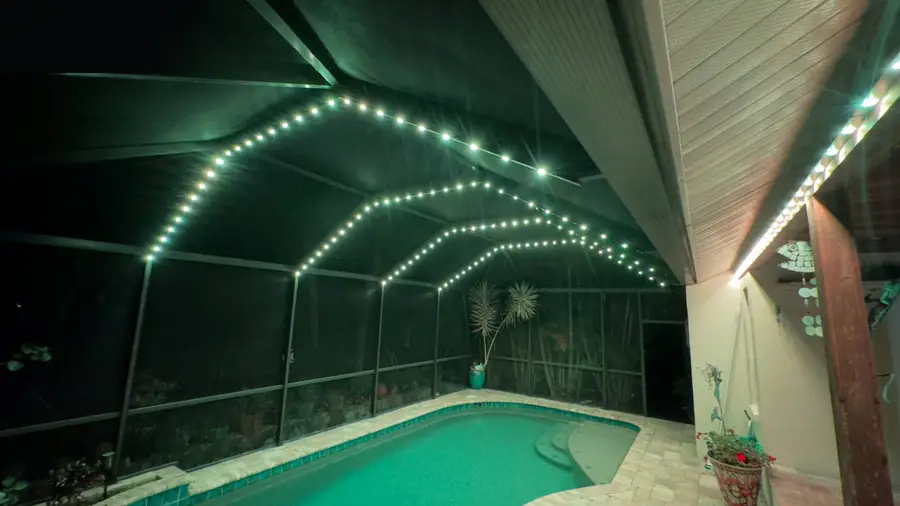
Deck perimeter lighting marks the edge of the pool at night, which matters as much for safety as for looks. Step lights at any grade change from patio to deck to pool edge come next, since that transition is where most nighttime slips happen.
Underwater and near-water fixtures are a specialized install with their own electrical requirements, handled separately from perimeter deck lighting and always by a fully insured, certified crew.
A pool house or cabana, if the property has one, often gets its own uplighting treatment, tying the whole deck zone together visually rather than leaving the structure dark while the surrounding deck is lit.
- Deck perimeter, marking the pool edge after dark
- Steps and any grade change near the water
- Pool house or cabana walls, warm white uplighting
- Landscaping around the pool fence line
Warm white for most of the season, color for the party
Warm white is the everyday default on a pool deck because it does not fight with the blue of the water or the sun-bleached look of most decking. It also reads well in evening photos if the pool is a selling point for the property.
Color-changing fixtures earn their place for a graduation, a Fourth of July gathering or a birthday. thraxel.com/blog/warm-white-vs-color-landscape-lighting/ walks through when the added cost of RGB actually pays off versus when warm white alone does the job.
A pool deck is one of the zones where color genuinely gets used, more than a front-yard tree or a driveway ever will, simply because it is the space families actually gather in after dark all summer.
Season-end and season-start realities
Western PA pool decks go dormant for several months a year, and fixtures left through a full winter freeze without the right housing rating are the ones that fail come May. Marine-grade housing is what lets a system sit through that dormancy without a callback.
Annual preventive maintenance and ongoing service plans catch a fixture that has drifted or dimmed before the pool reopens for the season, rather than finding out the first weekend it is full.
A pre-season check ahead of opening day is worth scheduling specifically for pool zones, since it is the one area of a property where a dead fixture is discovered by a crowd of guests rather than quietly by the homeowner.
Getting a pool deck quoted
A walkthrough looks at deck material, distance from the water, existing electrical and how the deck connects to the rest of the yard, since a pool zone rarely stands alone on a full property plan. National industry estimates commonly run roughly $150 to $400 installed per fixture, with pool zones often needing more fixtures per linear foot than a standard bed because of the perimeter and step requirements.
Request a free on-site consultation at thraxel.com/quote/ before the next pool season opens.
Financing at 0% APR for up to 24 months is available for qualifying buyers, which can make sense for a full pool deck package planned ahead of a specific summer rather than piecemeal over several seasons.
Pairing pool lighting with the rest of the backyard
A pool rarely sits in isolation on a property. Fence lines around the pool enclosure, an adjacent patio or firepit, and the landscaping between the pool and the house all benefit from being planned as one connected zone rather than lighting the pool deck and leaving everything around it dark.
A pool that backs up to a wooded lot or a sloped yard also needs its perimeter treated as a safety zone in its own right, since the transition from lit deck to unlit yard is exactly where someone unfamiliar with the property could misjudge the edge.
Homeowners planning a full backyard renovation around a pool often find it easier and less disruptive to have lighting designed and installed alongside the hardscape work rather than trenching a finished deck later, which is worth raising early with any contractor involved.
New pool construction and lighting design go together especially well, since wire runs can be planned into the excavation and hardscape phase before decking and coping are set, saving both cost and disruption compared to retrofitting a completed pool deck a year or two after it opens.
Above-ground pools and smaller plunge pools still benefit from the same perimeter safety approach, scaled to size, even though the fixture count and overall scope tend to be smaller than a full in-ground installation with a surrounding deck. A hot tub or spa tucked into the corner of a deck is worth including in the same conversation, since it often draws just as much evening use as the pool itself.