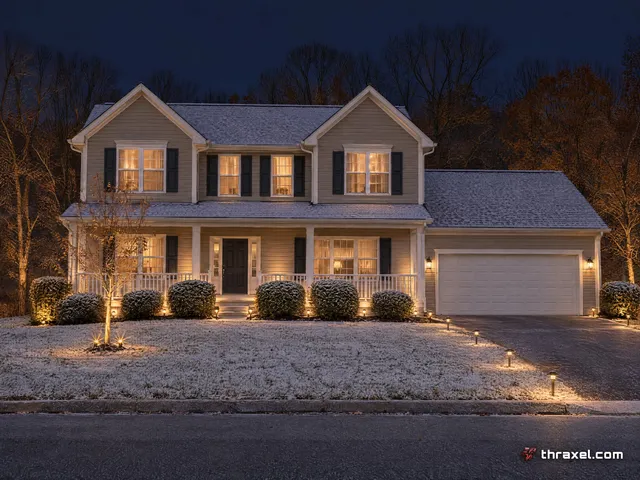
Material spotlight
Lighting a stone home means two systems, not one
A stone home is really two lighting jobs on the same house. Roofline track handles the eaves and peaks the way it would on any home. The stone itself is a different question, answered with uplighting, not track.

Two zones, two different tools
The roofline and eaves on a stone home get treated the same way as any other exterior: color-matched aluminum track fitted tight to the fascia, running the same eave, soffit and gable zones we would plan on a brick or vinyl home.
The stone facade itself is a separate zone entirely, and it does not use roofline track at all. Uplighting fixtures set into the landscape bed at the base of the wall throw light upward across the texture of the stone, which is what actually shows the material off after dark.
Homeowners sometimes ask why the two zones are not just one continuous system. The honest answer is that track along a roofline and ground-mounted uplighting solve different problems, and combining them into a single run would do a worse job at both.
Thinking of a stone home as two connected projects rather than one also helps with budgeting, since the two zones can be phased if needed, roofline first and stone uplighting added in a second visit, without either one being incomplete on its own in the meantime.
Why stone wants light from below
Stone has depth that flat siding does not. Mortar joints, natural color variation and surface texture only show up when light rakes across the wall at an angle, which is exactly what a ground-mounted uplight fixture does and a roofline run cannot.
A roofline-only approach on a stone home lights the top of the house well and leaves the wall itself flat and dark, which undersells the one material feature that usually justified paying more for stone in the first place.
Fieldstone, cut ashlar and manufactured stone veneer all behave slightly differently under raking light, since the surface texture and joint pattern vary between them, which is one reason the fixture placement gets confirmed on-site rather than assumed from a general rule.
Where uplighting fixtures actually go
Fixtures are placed in the landscape bed a short distance from the foundation, angled up at the wall rather than straight vertical, since a direct vertical throw tends to wash out texture instead of revealing it.
Corners and any architectural stone features, an arched entry, a chimney, a bay window surround, usually get their own fixture rather than relying on spill light from a neighboring one. That is part of the general landscape lighting design process, covered at thraxel.com/landscape/.
- Roofline and eaves: color-matched track, same as any material
- Stone facade: ground-mounted uplighting, warm white or color-changing
- Arches, chimneys, bay features: individual dedicated fixtures
What to skip on a stone home
We do not run roofline track down the face of a stone wall trying to substitute for uplighting. Track is built for a fascia mount along a roof edge, not a vertical stone surface, and forcing it there produces a worse result than the correct fixture would.
We also do not uplight a stone wall that sits close against dense landscaping unless the beds are cleared enough for a fixture to actually throw light on the stone rather than into a shrub.
We do not oversaturate a stone facade with color-changing uplighting as the default either. Warm white is usually the recommendation for a stone wall, since it reads as architectural lighting rather than a display, with color reserved for a specific scene or holiday rather than the everyday setting.
Partial stone facades
Not every stone home is stone from foundation to roofline. A lot of the homes we quote use stone as an accent on a lower level or chimney base while the upper stories are sided in brick, vinyl or wood, a common combination across newer construction in this region.
On those partial-stone homes, the uplighting zone only covers the stone section itself, while the roofline track runs the same way it would on a house with no stone at all. The two zones do not need to match visually, since they are highlighting genuinely different materials on the same facade.
This is actually the more common version of a stone home we quote, full stone exteriors being less frequent than a stone accent wrapped around an entry or chimney base.
Controlling both zones together
Roofline track and stone uplighting run on the same Thraxel Lighting app even though they are physically separate systems, so a scene change, warm white for an evening or color for a holiday, moves across both zones at once if that is how you want it set up.
You can also keep them independent, warm uplighting on the stone every night of the year while the roofline shifts for Halloween or the Fourth. That flexibility gets mapped out during the free consultation, not guessed at afterward.
Most homeowners with a stone accent wall settle on keeping the uplighting warm and constant while letting the roofline carry the seasonal or event-based color changes, since it lets the stone read as a permanent architectural feature rather than something tied to whatever scene happens to be running that week.
Getting a stone home rendered
Stone homes take a bit more time on the render than a single-material house, since the mock-up has to show both the roofline and the facade uplighting on your actual photo, but it still comes back within 24 hours.
Text Thraxel at 724-859-4390 with photos of the stone sections you care about most and we can start scoping fixture count before the on-site visit.
Because uplighting fixtures sit at ground level rather than up on the roofline, most stone home installs are quick to complete once the fixture count is finalized, often finishing in the same one to two days a comparable roofline-only job would take.