By home style
How we light a modern farmhouse without fighting the black trim
Board-and-batten siding, black window frames, a steep central gable and a porch that runs the width of the house. Modern farmhouses give permanent lighting more angles to work with than almost any other style we quote.
The three zones a farmhouse almost always needs
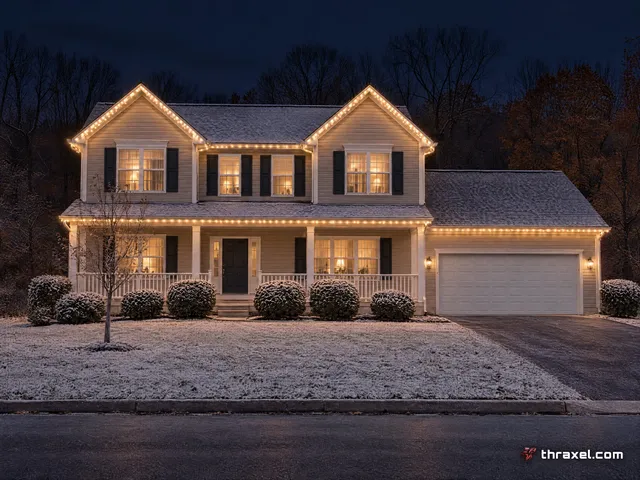
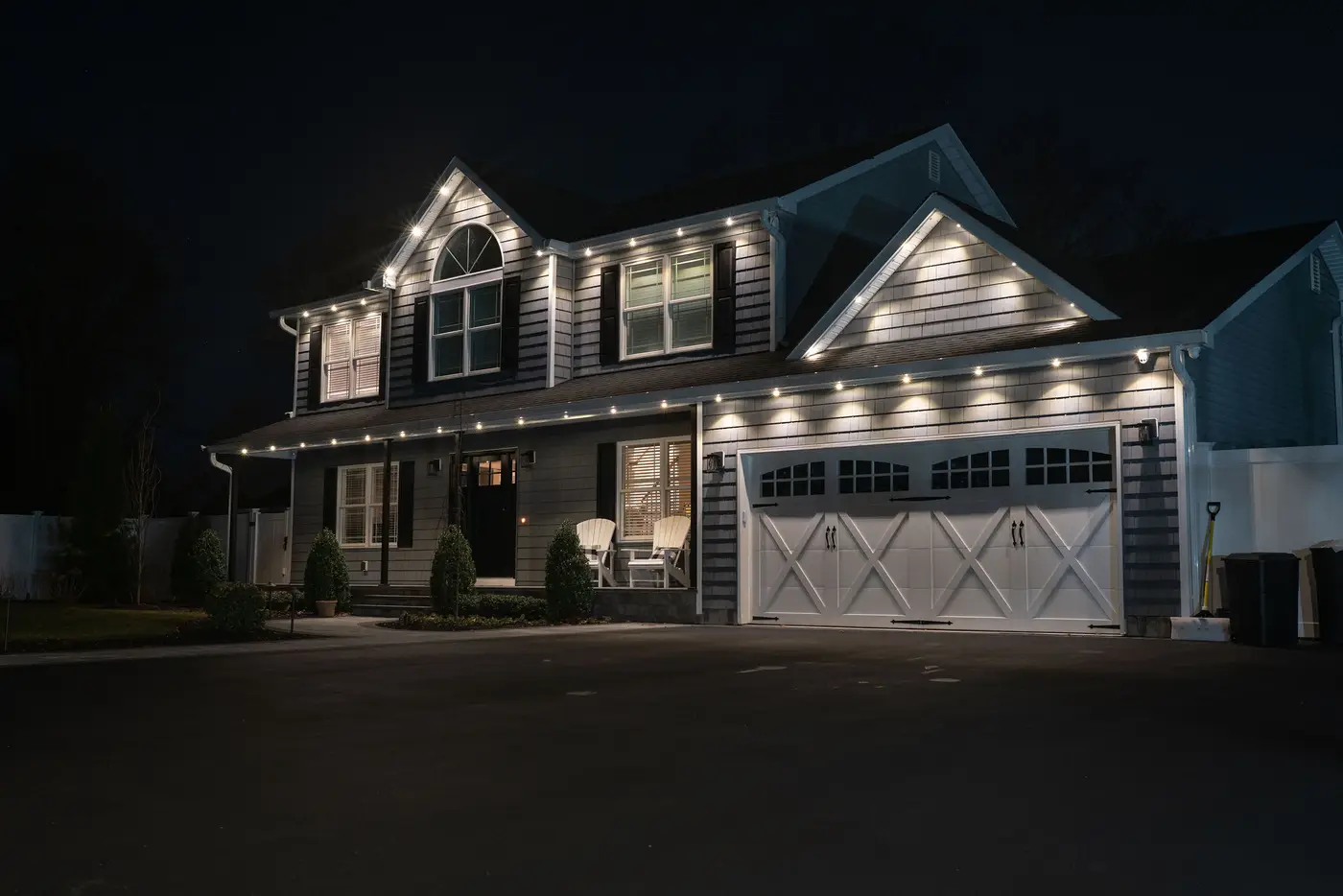
Most modern farmhouses we quote break into three clear lighting zones: the main roofline and eaves, the steep central gable peak that usually anchors the front elevation, and the porch beam that spans the entry.
That central gable is the part homeowners care about most. Tracing the two angled edges up to the peak gives the house its signature shape at night, the same shape that made the style popular on the street to begin with.
The porch beam, when there is a full-width covered porch, gets its own run separate from the roofline above it. Splitting the two zones lets the app control them independently, warm white on the porch while the roofline runs a color scene for a holiday.
Dormers and secondary gables
Farmhouse plans built in the last decade often add one or two smaller dormers or a secondary gable over a garage bump-out. Each of those gets evaluated on the consult rather than automatically lit, since a house with too many traced peaks starts to look cluttered instead of architectural.
Our general rule: if a dormer is visible from the street and roughly matches the pitch of the main gable, it earns its own short run. If it sits low and mostly faces a side yard, we usually leave it dark and let the primary roofline carry the design.
A secondary gable over an attached garage bump-out is a slightly different call. If the garage sits forward of the main house, that gable often gets included since it is the first roofline a visitor sees pulling into the driveway, even if it is smaller than the central peak.
Black trim and color-matched track
Farmhouses lean heavily on black window frames, black gutters and sometimes a black-trimmed porch rail. Color-matched aluminum track disappears against that trim by day the same way it disappears against white or tan fascia, since the color match is done per house, not off a single stock finish.
At night the effect is the opposite of daytime invisibility. A dark trim package makes the lit roofline look sharper against the siding, because there is less competing detail for the eye to sort through before it lands on the light.
White or light gray board-and-batten siding, the most common wall color on this style, also gives the roofline glow more room to read against by contrast, since the trim and the fascia sit close together in tone during the day and separate cleanly once the lighting is running at night.
What we skip on a farmhouse
We generally skip individually tracing every board of a board-and-batten wall section. The vertical siding pattern is a daytime texture, and trying to echo it with light at night usually looks busier than the house intended.
Metal roof accents, common on newer farmhouse builds over a porch or bay, are handled case by case. Track mounts to the fascia edge, not the metal panels themselves, so a metal roof section does not change the plan much beyond confirming a clean mounting edge exists.
- Skip: tracing individual siding boards
- Skip: automatically lighting every small dormer
- Confirm on-site: metal roof fascia edges and porch beam depth
The design mock-up on a multi-gable house
A farmhouse with a central gable, two dormers and a porch beam has more decision points than a simple ranch roofline, which is exactly where the free design mock-up earns its keep. You see the actual peaks traced on your actual photo within 24 hours, not a generic rendering of a similar-looking house.
That is usually where the dormer question gets settled. Homeowners see both options side by side in the mock-up, gable-only versus gable-plus-dormers, and pick the one that matches how the house should read from the road. Details on the process are at thraxel.com/permanent/.
Scenes that suit a farmhouse look
Because farmhouses lean on a neutral, high-contrast exterior palette, the Everyday Warm scene tends to look at home on them year-round, a true 2700K white rather than a mixed RGB approximation. The same system swaps to Christmas or Halloween scenes without anyone touching the track.
For a full comparison of how that plays out against a traditional seasonal C9 install, see thraxel.com/blog/lighting-a-craftsman-bungalow/ for a different style's take on the same warm white question.
Fence lines and rural acreage
A meaningful share of the modern farmhouses we quote sit on larger rural or semi-rural lots, sometimes with a fence line marking a pasture edge or property boundary rather than a small suburban yard. That fence line is one of the zones Thraxel lights, and it comes up more often on farmhouse-style properties than on any other home style we cover in this series.
Fence line lighting is a separate project from the roofline package, priced and scheduled on its own, but homeowners with both the house and a stretch of fence in mind often plan them during the same on-site visit so the crew only has to walk the property once.
It is worth mentioning specifically here because the style itself, more than any other, tends to come with the acreage that makes fence line lighting a realistic add-on rather than a hypothetical one.
Booking a farmhouse consult
Farmhouse installs with a central gable, dormers and a full porch beam usually run one to two days depending on total linear footage across the three zones. Financing at 0% APR for up to 24 months is available for qualifying buyers if the full multi-zone package is more house than a single payment covers.
Reach Thraxel directly at 724-859-4390 to get a render started, or start the request online at thraxel.com/quote/.