Keeping it running
What a landscape lighting maintenance plan actually covers
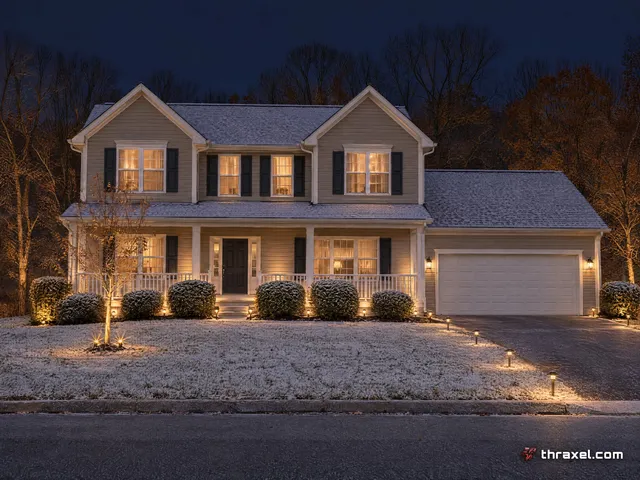
A landscape system does not fail all at once. It drifts: a fixture tilts, a lens fogs, a connection loosens under freeze-thaw. A maintenance plan catches that drift before a homeowner notices half the yard has gone dim.

Why landscape fixtures need more attention than roofline lighting
Permanent roofline lighting sits fixed on color-matched track under the eaves, largely undisturbed. Landscape fixtures live in the ground or in beds, exposed to mowing, mulching, freeze-thaw movement and whatever a dog, a snowblower or a landscaping crew does near them.
That exposure is exactly why annual preventive maintenance exists as a separate offering for landscape zones. It is not that the equipment is lower quality, it is that the environment around it changes more.
A property with an active landscaping crew, seasonal mulch refreshes, bed edging, plant additions, sees more incidental fixture disruption than a property that is largely left alone between seasons, which is worth mentioning to your maintenance visit if it applies to you.
What actually gets checked
A maintenance visit walks the full system zone by zone, checking fixture aim, connection integrity, lens condition and whether anything has been buried, covered by new mulch, or knocked out of position since the last visit.
It also checks the transformer and timer settings, since an astronomical timer set correctly at install can occasionally need a coordinate or schedule check, especially after a power outage resets a controller.
Bulb and pixel brightness gets compared across the system too, since a fixture that has quietly dimmed relative to its neighbors is often an early sign of a connection problem rather than a component that needs full replacement.
- Fixture aim and position, reset after any drift
- Connections and wire integrity at each junction
- Lens and housing condition, cleaned or replaced as needed
- Transformer output and timer or controller settings
What freeze-thaw specifically does to a system
Western PA gets more freeze-thaw cycles in a typical winter than a lot of the country, and each cycle moves ground that a fixture is set into, even slightly. Over several winters, that adds up to a fixture aimed noticeably off from where it started.
Catching that early, on a scheduled visit, is a lot cheaper than letting it go for years until a homeowner realizes a whole bed has been lit wrong for two seasons. See thraxel.com/blog/freeze-thaw-cycles-and-landscape-lights/ for more on how that movement happens.
Spring, right after the last hard freeze, is often the most useful time for a maintenance visit specifically because it comes right after the season that does the most ground movement, letting a crew reset everything before summer use ramps up.
Service plans versus one-off calls
Thraxel offers ongoing service plans in addition to one-time repair calls, and the plan route is almost always the better value for a system with more than a handful of fixtures. A scheduled visit catches small issues before they become a call for a fixture that has been dark for months.
It also means a homeowner never has to be the one who notices a problem first. The system gets checked on a schedule, not just when something visibly goes wrong.
A plan also builds a service history for the property, which is useful if a homeowner ever needs to reference what was checked, replaced or adjusted in a prior year rather than starting from scratch on every visit.
Setting up a plan
Maintenance plans get scoped based on the number of zones, fixture count and site conditions, since a river-adjacent property or a heavily wooded lot needs more frequent attention than a flat, open yard. Ask about it on your next consult or reach out directly.
Call or text Thraxel at 724-859-4390 to talk through what a plan would look like for your specific property.
It is a reasonable question to ask an installer directly, whether maintenance is offered at all and how it is priced, since not every lighting company treats it as a standing service rather than a one-off callback.
What happens if a system goes unmaintained
A landscape system left completely unchecked for years does not stop working overnight. It fades gradually, one dimmed lens here, one drifted fixture there, until a homeowner one evening realizes the whole yard looks noticeably less finished than it used to and cannot quite place why.
By that point, the fix is usually still straightforward, resetting aim, cleaning housings, checking connections, but it takes longer as a single catch-up visit than it would have across several smaller, scheduled checks. Deferred maintenance on a lighting system behaves a lot like deferred maintenance on anything else outdoors.
The good news is there is no point at which a system is too far gone to bring back. Even a yard that has not been touched in three or four years can usually be brought back to its original design with a thorough visit rather than a full re-install.
The comparison worth keeping in mind is a car that never gets an oil change. It will still run for a while, then the cost of catching up all at once tends to be higher than if smaller, regular service had kept pace with it the whole time.
A first maintenance visit on an older, unmaintained system also gives an installer a clear picture of the property's actual conditions, soil type, drainage, sun exposure, that can inform whether the original design still fits or whether a small adjustment would serve the property better going forward. Mature landscaping that has grown in since the original install, new tree canopy, thicker shrubs, is another common reason a design benefits from a fresh look.