From ladder to service
How Christmas lighting went from a Saturday chore to a professional service
There was a time when every string of Christmas lights in Western PA went up by a homeowner's own hand, on their own ladder, on whatever Saturday the weather allowed. That is no longer the default. Here is how the job changed.

The electric era begins
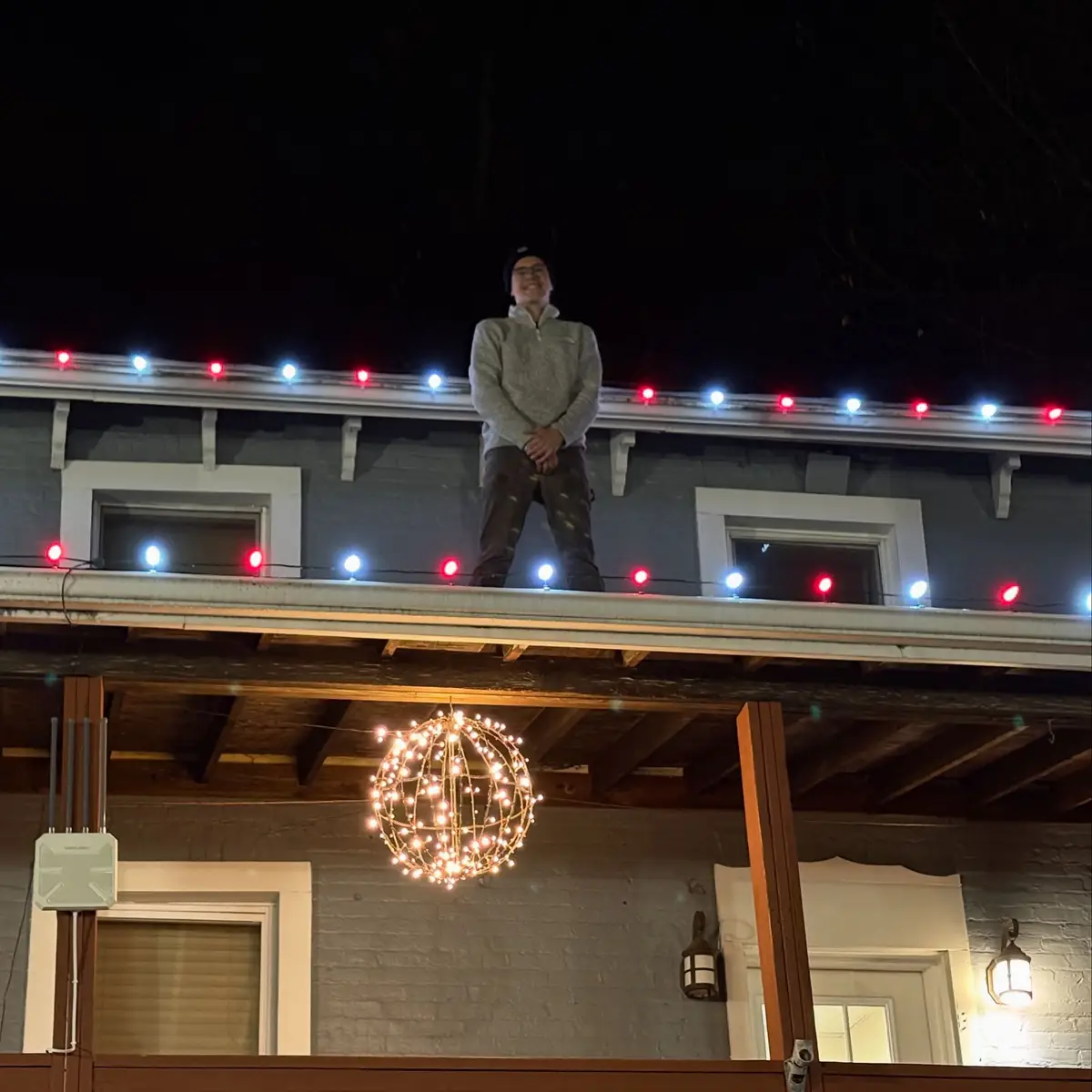
Electric Christmas lights replaced candle-lit trees in the early twentieth century, and outdoor displays followed once bulbs, sockets and weatherproof wiring became affordable enough for a typical household. For most of that era, the labor was entirely DIY. Someone in the house owned a ladder and used it every December.
That model held for generations. Buying strings of lights, testing them in the garage, and climbing to the roofline was simply part of the season, the same way raking leaves was part of fall. There was no service to call because the service did not exist yet, and nobody expected one to.
Neighborhoods across Western PA grew up on that model, and it shaped a lot of the informal skill sharing that still shows up in older families today, a father teaching a son how to string a roofline safely, a mother keeping the box of ornaments organized by which window they belonged in.
Post-war suburbs raise the stakes
The suburban building boom after the second world war put more roofline, more shrubbery and more front yard per household than earlier city blocks ever had. Displays got bigger because there was more house to decorate and more room on the lawn for a lit figure or two.
Bigger displays meant more time on a ladder and more that could go wrong: a burnt bulb mid-string, a staple through a wire, a fall off a wet roof in November. The DIY model scaled with the house, but the risk scaled right along with it, and injuries connected to holiday decorating became common enough to draw attention from safety organizations nationally.
Western PA's own suburban growth followed a similar pattern through the mid-century decades, with larger lots and taller rooflines in newer developments outside towns like Butler and Kittanning giving households more house to light than their parents' generation ever had to manage.
The 1990s and 2000s: lighting becomes a trade
Professional holiday lighting installers began showing up as a distinct trade through the 1990s and 2000s, offering design, installation, in-season repair and takedown as one package rather than a one-time hang-it-and-hope job. Homeowners were, for the first time, buying a season of service instead of a box of bulbs.
The shift tracked a broader change in how people spend time. Fewer households had a spare Saturday for roofline work, and more were willing to pay someone insured and trained to take the risk instead. A trade that barely existed a generation earlier became a normal line item on a December budget.
This period also saw the first commercial-grade lighting products built specifically for professional installers rather than retail shelves, which raised the ceiling on what a hired crew could offer compared to a store-bought kit strung up by hand.
What a full-service install actually includes now
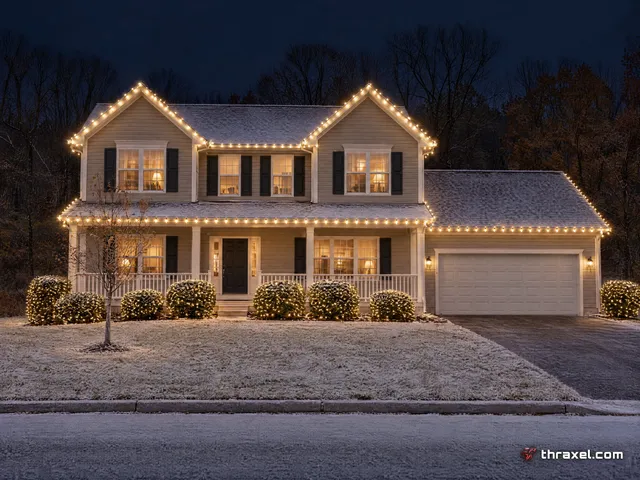
Thraxel's seasonal program follows that same service arc: design and a mock-up of the actual house, installation by a trained crew, in-season maintenance with any issue fixed within 24 to 48 hours at no charge, and takedown starting January 4 with the lights labeled and stored until next year.
Nothing about that list existed in the ladder-and-a-Saturday version of Christmas lighting. It is a full loop, not a single afternoon, and it treats the display the way a service business treats any recurring commitment, with a defined start, an active maintenance period, and a defined close.
- Design and a property-specific design mock-up before install
- Crew installation, weather permitting, with the ladder risk on them, not you
- Repairs handled within 24 to 48 hours through the season
- Takedown starting January 4, with lights labeled and stored
Why Western PA adopted it early
An early, unpredictable winter makes the DIY version harder here than in milder climates. A ladder on a frosty roof in Armstrong or Butler County is a different proposition than the same job somewhere that stays above freezing until January. That risk profile is part of why the service model caught on quickly across the region.
Thraxel grew directly out of that shift, starting as 160 Glow hanging seasonal lights across Western Pennsylvania before the current name and the permanent system joined the lineup. Same brothers, same crews, more options than a Saturday ladder ever offered. More at thraxel.com/christmas/.
The company's own trajectory mirrors the trade's broader history almost exactly: a family that started doing seasonal install work by hand, and grew into a full-service operation as demand for the safer, more convenient version of the job kept climbing.
What has not changed along the way
For all the change in who does the physical work, the underlying goal has stayed constant since the earliest electric strings went up: a lit house for the darkest weeks of the year. The service model did not invent a new reason to decorate, it just made the old reason accessible to more households, including the ones who had aged out of the ladder or never had the time for it in the first place.
That is probably the clearest way to understand the shift. Christmas lighting did not become a service because people wanted something new. It became a service because the old way of getting the same result stopped making sense for a lot of families.
The permanent lighting category that followed the seasonal-service model a bit later is really just the next step in that same evolution, trading a repeated annual service for a single install that removes the recurring scheduling problem entirely, at the cost of a larger up-front project.
Looking at the whole arc together, from a homeowner on a ladder, to a booked seasonal crew, to a permanent system controlled from a phone, each step removed a little more of the physical labor and a little more of the annual scheduling risk, while keeping the same basic outcome a lit house through the darkest stretch of winter.