Mahoning Valley, OH
Permanent lighting in Youngstown: the Ohio end of the Route 422 corridor
US 422 runs right past Kittanning and ends up in Youngstown, about 90 miles later. We follow it for permanent lighting installs in the Mahoning Valley, grouped with New Castle and Hermitage on the Pennsylvania side. Here is how a batched Ohio install works and what the system does once it is on the house.

Following 422 west
US 422 runs through Kittanning, and if you stay on it long enough you end up in Youngstown. The trip is about 90 miles and an hour and forty-five minutes, which puts the Mahoning Valley in our regional tier rather than on the daily route we run across the 16xxx ZIP codes.
Regional means we batch. New Castle sits about 65 miles from us on the same road and Hermitage about 78, so an Ohio trip normally picks up consults and installs in Lawrence and Mercer County on the way out and the way back. A crew leaves with a full trailer, works several properties in a row, and does not come home between them.
That is the honest tradeoff of hiring a family company from across the state line: you wait for the run, and then the run gets done. The city page at thraxel.com/areas/youngstown/ has the current picture for the Valley, and thraxel.com/areas/hermitage/ covers the Pennsylvania side.
Brick ranches, colonials and the suburbs south of town
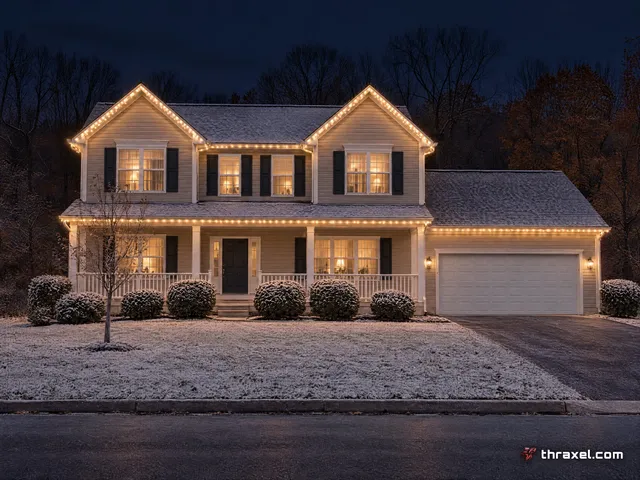
Most of the Youngstown work we quote is in Boardman, Canfield, Poland and the neighborhoods that ring Mill Creek Park, where the housing is a mix of postwar brick ranches, two-story colonials and newer builds on larger lots. Each one takes track differently.
A long, low ranch is the easiest roofline there is: one clean run of track across the front fascia and it is done. A colonial gets the main eave plus the gable returns, and a house with a front porch gets a second zone so the porch can run a different color than the roof. On a brick facade, we pair the roofline with a few warm uplights so the wall reads at night.
What you are actually buying
A permanent system is color-matched aluminum track mounted once along the fascia, with RGBWW pixels inside it. RGBWW means red, green and blue diodes plus a dedicated 2700K warm-white diode, which is why the everyday scene looks like a warm porch light instead of a bluish LED strip. Each pixel is individually addressable and is sealed in IP67 marine-grade silicone on 16-gauge wire.
You run it from the Thraxel Lighting app: colors, warm white, saved scenes, music sync. It also works with Alexa, Google Home, Apple HomeKit and Control4, so a house that already has voice control can fold the roofline into it. The primer at thraxel.com/blog/what-is-permanent-exterior-lighting/ walks through the parts in more depth.
- Color-matched track, tucked to the fascia, invisible by day
- 16 million colors plus true 2700K warm white
- App, voice assistant and Control4 control
- 3-year parts warranty, 1-year labor
Lake snow, valley wind and the durability question
Youngstown catches the southern edge of the lake-effect bands off Erie a few times each winter, plus the same wet, heavy snow and ice we get in Armstrong County. The pixels are rated IP67, the housing is salt-tested, and the track is fastened to the fascia rather than hung from the gutter, so ice load does not pull on the lights.
If a pixel does fail, the controller tells us which one. We do not hunt with a ladder. Same-day replacement is typical when a crew is on site, and parts are covered for 3 years.
Scenes the Valley actually uses
The Mahoning Valley splits its Sundays between the Steelers and the Browns, and a permanent roofline does not take sides: black and gold or orange and brown is one tap either way. Scarlet and gray on a Saturday works the same. Halloween orange and purple, red and green for Christmas, red, white and blue in July, and Everyday Warm the rest of the year are all built in.
The power cost is small enough to ignore. A typical 168-LED system running six hours a night costs about $52.80 a year to operate.
Cost, financing and getting on the run
Thraxel prices are not published, because roofline length, peaks and zones change everything. As a reference point only, national industry estimates commonly fall between roughly $20 and $50 per linear foot installed for permanent systems, and your property will differ, which is why the quote is free. Qualifying buyers can finance at 0% APR for up to 24 months.
To start, call or text Thraxel at 724-859-4390 or fill out thraxel.com/quote/. He will slot the consult into the next Mahoning Valley run, bring the demo case with four live RGBWW strips to the driveway, and send a render of your house within 24 hours. Installs typically take one to two days.