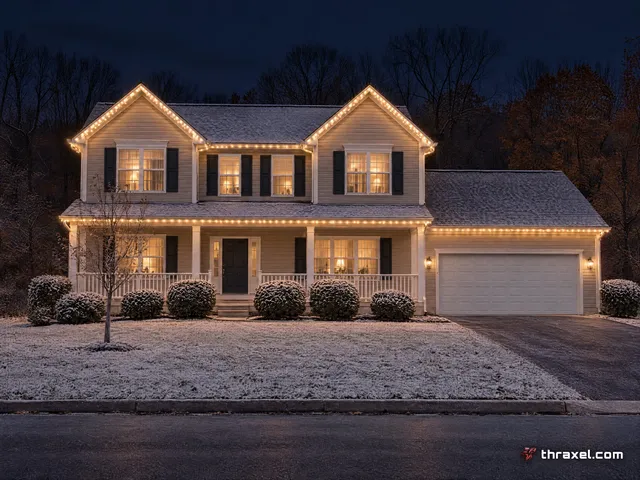
What you are looking at
Why every photo on our site is a real install
The homes, rooflines and commercial buildings on thraxel.com are real Thraxel installs, not stock photography licensed to look like the work. What you see is what a crew actually put on a property in Western Pennsylvania or the region around it.

Stock photography is a shortcut we skip
A lighting company's website is easy to fill with licensed images of glowing rooflines that no crew from that company ever touched. It is fast, it always looks flattering, and it tells a homeowner nothing true about what the actual install will look like.
We build thraxel.com without that shortcut. The homes shown are properties Thraxel crews wired, mounted and walked through with the homeowner at the end, in the same Kittanning-based service area described on the site itself.
It takes more effort to run the business this way. A finished job has to be photographed properly after dark before it can go anywhere on the site, and a slow month of installs means a slower month of new gallery images too.
That trade-off is intentional. A slower-growing, entirely real gallery is worth more to a homeowner deciding whether to hire Thraxel than a fast, polished set of images that could belong to any lighting company in the country.
It also makes the gallery a rough timeline of the company's own growth, from early residential rooflines to the commercial work that came later, rather than a static set of images that never changes.
A returning visitor comparing the gallery to a version they saw a year earlier is looking at genuinely new work, not a refreshed layout wrapped around the same handful of licensed images.
What that means for the gallery
Roofline shots, landscape installs, commercial buildings and dock lighting on the site all come from finished jobs, not a photo library. A stone home with warm architectural uplighting, a boat dock lit for the evening, a two-story colonial traced in permanent track, these are jobs, not props.
It also means the site cannot promise a look that the actual system cannot deliver. If a photo shows warm-white roofline lighting reading as clean, even light, it is because the real RGBWW system with its dedicated 2700K diode produces that look, not because a photo editor did.
A homeowner scrolling the gallery is effectively previewing what their own street already has installed nearby in some cases, since several images come from towns on the daily route rather than distant, unfamiliar cities.
The demo case does the same job in person
This philosophy is also why every consultation includes the driveway demo case: a tactical hard case with four live RGBWW strips, 128 LEDs, controlled from the app right there on your property. It is the in-person version of not using stock photography, seeing the actual light rather than a picture of someone else's.
Combined with a design mock-up of your specific house within 24 hours, a homeowner is working from real evidence at every step, not marketing images pulled from somewhere else.
It is a small thing to bring a physical case to a driveway instead of relying on a brochure, but it is consistent with the same instinct that keeps stock imagery off the website: show the real thing whenever it is possible to.
Honesty about trade-offs is the same instinct
Not using staged images connects to a broader habit at Thraxel: saying plainly when a system is not the right fit. Permanent lighting is not the better buy for a house about to be re-roofed this year, and seasonal Christmas lighting is not the right choice for someone who wants the roofline lit for more than one holiday.
A site built on real photos supports that kind of honesty. It is harder to oversell a system when every image on the page has to be a job the company can actually stand behind.
That same standard applies to the words on the page, not just the pictures. Facts about the system, the warranty and the service area are kept to what can actually be verified, rather than the kind of exaggerated claims that stock photography often gets paired with elsewhere.
Where the real work shows up
Commercial installs at restaurants, hotels, office parks and plazas are treated the same way, no rendered visualizations passed off as finished photography. What a property manager sees in the gallery at thraxel.com/gallery/ is what a crew actually delivered on a job of that scale.
Residential work gets the same standard. A homeowner comparing thraxel.com/permanent/ against another company's site is comparing real installs against whatever the other company chose to license.
It is a fair comparison to make directly. A gallery of only real jobs will naturally show more variety in house style, roofline shape and lighting color than a curated stock library ever would, because it reflects actual customers rather than a designer's idea of a perfect house.
See your own property, not a stock photo
The point of skipping stock photography is ultimately about your house, not ours. A free on-site consultation and a design mock-up put your actual roofline into the process instead of a generic image standing in for it.
Start one at thraxel.com/quote/, or browse only-real installs at thraxel.com/gallery/ before you do.
Either way, what you are evaluating is real work done by the same crew that would be doing yours, not a curated set of images meant to sell a feeling rather than a finished job.
A photo of someone else's actual finished house tells you more about what to expect than any stock image ever could, even if that specific roofline looks nothing like yours. It shows the standard, not just a mood.